迷你百科 · 昆明与云南A pocket guide · Kunming & YunnanGuía de bolsillo · Kunming y Yunnan
春城风土The Spring City, and the land around itLa Ciudad de la Primavera y la tierra que la rodea
我们端上桌的,不只是一碗米线。是昆明清晨菜市场的吆喝,是街角米线铺的白汽,是一代代人传下来的日子。这本小册子,从一碗米线讲起。What we serve is more than a bowl of noodles. It is the morning market in Kunming, the steam rolling out of a corner noodle shop, and a way of life handed down over generations. This little guide begins, naturally, with the bowl.Lo que servimos es más que un tazón de fideos. Es el mercado de Kunming a primera hora, el vapor que sale de una fonda de esquina y una manera de vivir que ha pasado de generación en generación. Esta pequeña guía empieza, como no podía ser de otro modo, por el tazón.
米线是什么?是一把米,是一方水土,也是昆明人每天早上的那一口热乎。What is mixian? A handful of rice, a particular patch of earth — and the hot first mouthful of almost every morning in Kunming.¿Qué es el mixian? Un puñado de arroz, un pedazo de tierra muy concreto y el primer bocado caliente de casi todas las mañanas en Kunming.
清晨的菜市场Morning at the marketLa mañana en el mercado
In many Kunming households, mixian was something you made at home. Early in the morning you took a basket to the market. First a bunch of garlic chives, deep green and still damp; then on to the noodle stall to ask for èr liǎng — two liang, about a hundred grams, a breakfast-sized portion. The stallholder grabbed a handful from the soft white heap, dropped it on the scale, a little over or a little under, and handed it across with a smile.
En muchos hogares de Kunming, el mixian se preparaba en la propia cocina. Temprano por la mañana se iba al mercado con la canasta. Primero, un manojo de cebollín chino, bien verde y todavía húmedo; después, al puesto de fideos, a pedir èr liǎng: dos liang, unos cien gramos, la porción justa para un desayuno. El vendedor tomaba un puñado del montón blanco y suave, lo ponía en la balanza —un poco más, un poco menos— y se lo entregaba con una sonrisa.
Back home, the broth went on until it was at a rolling boil. The noodles and the chopped chives took a quick dip in the pot together and went into the bowl; then a spoonful of pickled greens, a spoonful of minced pork if there was some, and finally a drizzle of sweet soy and chili oil. Nothing complicated — yet every step had its own small rule. Only once that bowl was finished did the day properly begin.
De vuelta en casa, se ponía el caldo a hervir a borbotones. Los fideos y el cebollín picado se daban un baño rápido juntos en la olla y pasaban al tazón; luego, una cucharada de verduras encurtidas, otra de carne molida si la había y, al final, un chorrito de salsa de soya dulce y aceite de chile. Nada complicado, pero cada paso tenía su pequeña regla. Solo después de ese tazón empezaba de verdad el día.
米线在昆明人的日子里Mixian in everyday Kunming lifeEl mixian en la vida diaria de Kunming
Out on the street, the corner noodle shop opens early too. Before the city is properly awake its pots have been going for a while, and steam rolls out of the door in clouds. Office workers, kids with their schoolbags still on their backs, shoppers back from the market with a bunch of chives in hand — they squeeze onto low stools, bend over their bowls, and for a few minutes hardly anyone says a word. Then they wipe their mouths and go their separate ways.
En la calle, la fonda de la esquina también abre temprano. Antes de que la ciudad termine de despertar, las ollas ya llevan un buen rato al fuego y el vapor se escapa por la puerta en nubes. Oficinistas, niños con la mochila todavía a la espalda, vecinos que vuelven del mercado con un manojo de cebollín en la mano: todos se acomodan en banquitos bajos, se inclinan sobre el tazón y, durante unos minutos, casi nadie dice nada. Luego se limpian la boca y cada quien sigue su camino.
Lunch can be mixian. So can the last meal after a late shift. And when New Year comes round, or the busy farming season, or guests turn up at the door, a big pot of broth goes on the stove, a basin of noodles comes out, and little dishes of toppings crowd the table — easy, generous, and never out of place.
El almuerzo puede ser mixian; la última comida después de un turno largo, también. Y cuando llega el Año Nuevo, o la temporada de más trabajo en el campo, o hay visitas en casa, se pone a hervir una olla grande de caldo, sale una fuente llena de fideos y la mesa se llena de platitos con acompañamientos: sencillo, generoso y siempre bien recibido.
昆明人吃米线的讲究How Kunming eats itCómo se come en Kunming
汤要烫。The broth must be hot.El caldo, bien caliente.一碗端上来,汤得滚烫冒气。温吞吞的米线,在昆明是要被嫌弃的。Properly, scaldingly hot. A lukewarm bowl is a small scandal in Kunming.Hirviendo, como debe ser. En Kunming, un tazón tibio es casi un escándalo.
韭菜不能少。Never without garlic chives.Que no falte el cebollín chino.一把切碎的韭菜,和米线一起在滚水里烫一烫,出锅时那股辛香一下就冒出来。没有韭菜的米线,昆明人总觉得少了点什么。A handful of chopped garlic chives goes into the boiling water with the noodles, and the moment they come out, that sharp green fragrance rises from the bowl. Mixian without chives always feels, to a Kunming palate, like something is missing.Un puñado de cebollín chino picado se cuece con los fideos en el agua hirviendo y, al salir, suelta ese aroma verde e intenso. A un paladar de Kunming, un mixian sin cebollín siempre le parece incompleto.
三鲜,要配豌豆尖。Three-treasure means pea shoots.Tres delicias, con brotes de chícharo.点一碗三鲜米线,昆明人会期待碗里有几根豌豆尖。嫩嫩的豆苗尖在热汤里一烫就软,碧绿碧绿,带着一股清甜。Order a three-treasure bowl in Kunming and you expect a few pea shoots in it — the tender tips of the pea vine, wilted in seconds by the hot broth, bright green and gently sweet.Quien pide un tazón de tres delicias en Kunming espera encontrar en él unas puntas de chícharo: los brotes tiernos de la planta, que el caldo caliente ablanda en segundos, de un verde intenso y un dulzor suave.
一勺酸腌菜。A spoonful of pickled greens.Una cucharada de verdura encurtida.云南人家自己腌的酸腌菜,酸香里带着一点辣。舀一小勺进碗,汤就有了层次,开胃,又解腻。Yunnan’s homemade pickled greens, suān yāncài, are sour and fragrant with a little heat. One small spoonful gives the broth depth, wakes up the appetite and cuts the richness.La verdura encurtida casera de Yunnan, suān yāncài, es ácida, aromática y lleva un toque de picante. Basta una cucharadita para darle profundidad al caldo, abrir el apetito y aligerar la grasa.
看「帽子」。Choose your “hat.”Elija su «sombrero».米线上的浇头,昆明人叫「帽子」:焖肉、肉末、脆哨、鳝鱼……点米线,其实是在点帽子。Locals call the topping the maozi, the “hat” — braised pork, minced pork, crispy pork bits, eel. Ordering mixian really means choosing a hat.A lo que va encima de los fideos, la gente de Kunming le dice maozi, «el sombrero»: cerdo estofado, carne molida, chicharrón, anguila… Pedir mixian, en realidad, es elegir sombrero.
小料自己配。Season it yourself.Sazónelo a su gusto.葱花、豆芽、辣椒油、花椒油,还有昆明人离不开的甜酱油——咸、甜、酸、辣,自己调到刚刚好。Scallions, bean sprouts, chili oil, Sichuan-pepper oil — and Kunming’s beloved sweet soy sauce. Salty, sweet, sour, hot: you tune it yourself.Cebolla verde, germen de soya, aceite de chile, aceite de pimienta de Sichuan y esa salsa de soya dulce sin la que Kunming no vive. Salado, dulce, ácido, picante: el punto lo pone usted.
趁热,大口。Eat it fast, eat it hot.Rápido y caliente.米线泡久了会胀、会软。吃米线不必斯文,热气腾腾地吸溜下去,才是对一碗好米线的敬意。Noodles soften as they sit. Mixian isn’t a dainty food — slurping it down while it steams is the highest compliment you can pay it.Los fideos se ablandan si esperan. El mixian no es comida de remilgos: comérselo mientras todavía humea es el mejor cumplido que se le puede hacer.
A bowl of Kunming mixian looks homely, but it is craft all the way down. Good fresh mixian starts with rice soaked for days, to earn that faint, elusive tang. The broth is simmered slowly from bones. Every topping has its own timing — braised pork cooked until it yields, crispy pork rendered until it crackles — and even how many chives, how much pickle, is a matter of judgment. So what we bring to your table is not just a bowl of noodles. It is a small piece of handiwork.
Un tazón de mixian de Kunming parece cosa de todos los días, pero de principio a fin es puro oficio. El buen mixian fresco empieza con un arroz que pasa días en remojo para ganarse ese toque ácido, apenas perceptible. El caldo se cuece despacio, con huesos. Cada «sombrero» tiene su punto: el cerdo estofado, hasta que se deshace; el chicharrón, hasta que cruje. Y hasta cuánto cebollín o cuánta verdura encurtida se le pone es cuestión de buen ojo. Por eso lo que le llevamos a la mesa no es solo un tazón de fideos: es una pequeña obra hecha a mano.
酸浆与干浆:两种手艺Two crafts: “sour-pulp” and “dry-pulp”Dos oficios: el mixian fermentado y el seco
To an old Kunming hand, this is the real thing. Rice is soaked for days and left to ferment gently, then ground, settled, steamed into dough, pressed through a die straight into boiling water and plunged into cold water to set. The fermentation leaves a whisper of tang and a deep rice fragrance, and the strands are soft, slippery and tender. It is delicate and doesn’t keep — made today, eaten today — which is why the best of it comes from small neighborhood workshops.
Para la gente de Kunming de toda la vida, este es el auténtico. El arroz se deja en remojo varios días para que fermente poco a poco; luego se muele, se deja asentar, se cuece al vapor hasta formar una masa y se prensa por un molde directamente sobre el agua hirviendo, para pasarlo después por agua fría. La fermentación le deja un susurro ácido y un aroma profundo a arroz, y las hebras quedan suaves, resbalosas y tiernas. Es delicado y no aguanta: se hace hoy y se come hoy. Por eso el mejor sale de pequeños talleres de barrio.
Skip the long fermentation: the rice is milled and extruded, then sun- or oven-dried. The result is springier, holds up to a long simmer without breaking, and travels well — soak it, boil it, and dinner is on. Most mixian eaten outside Yunnan is this kind, and it is often the choice for dishes that bubble away in the pot, like small-pot mixian.
Aquí no hay fermentación larga: el arroz se muele, se extruye y se seca al sol o al horno. Queda más firme, aguanta un hervor largo sin romperse y viaja bien: se remoja, se hierve y a comer. Casi todo el mixian que se come fuera de Yunnan es de este tipo, y también es el preferido para los platos que borbotean un rato en la olla, como el mixian de olla pequeña.
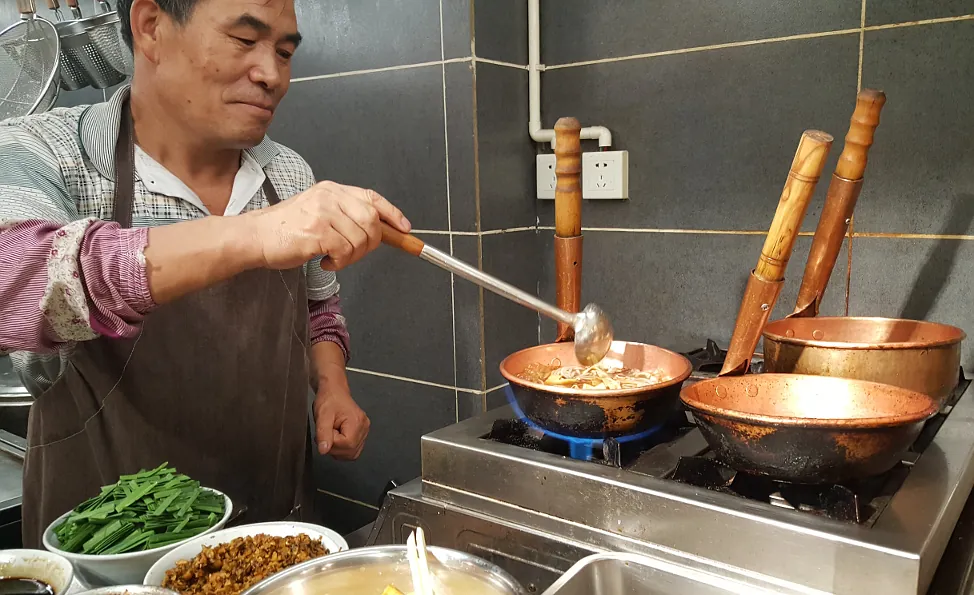
昆明一家米线馆里,一排小铜锅同时开火——一锅只煮一碗。In a Kunming noodle shop, a row of small copper pots on the flame — one pot, one bowl.En una fonda de Kunming, una fila de ollitas de cobre al fuego: una olla, un tazón.图:Photo: Foto: Pratyeka · CC BY-SA 4.0
昆明的米线The mixian of KunmingLos mixian de Kunming
小锅米线Small-pot mixian xiǎoguōMixian de olla pequeña xiǎoguō
Picture an old noodle stall in Kunming: a row of small copper pots over the flame, each one cooking a single bowl. In go minced pork, pickled greens, garlic chives and tender pea shoots; the pot bubbles for a minute, a spoonful of sweet soy goes over the top, and the whole thing is tipped into your bowl. Generally said to have come from nearby Yuxi in the 1920s, small-pot mixian is now the bowl Kunming calls its own — and the best of it is still found at those old street stalls.
Imagínese un viejo puesto de fideos en Kunming: una fila de ollitas de cobre sobre el fuego, y en cada una se cocina un solo tazón. Adentro van carne molida de cerdo, verdura encurtida, cebollín chino y brotes tiernos de chícharo; hierve un momento, se le echa encima una cucharada de salsa de soya dulce y todo pasa directo al tazón. Se dice que llegó de la vecina Yuxi en los años veinte del siglo pasado; hoy es el tazón que Kunming siente más suyo, y el mejor se sigue comiendo en esos puestos de siempre.
焖肉米线Braised-pork mixian mènròuMixian con cerdo estofado mènròu
慢火焖到酥软的猪肉切片,铺在热汤米线上,肥而不腻,是老昆明的家常味道。
Slices of slow-braised pork laid over noodles in hot broth — tender, rich, and deeply comforting. An old-Kunming everyday classic.
Rebanadas de cerdo estofado a fuego lento sobre fideos en caldo caliente: tierno, sabroso y reconfortante. Un clásico de todos los días en el Kunming de siempre.
豆花米线Douhua mixianMixian con douhua
嫩豆花盖在米线上,配肉末、酱油、辣油和葱花,是许多昆明人熟悉的早点。
Silken tofu pudding spooned over noodles with minced pork, soy, chili oil and scallions — the breakfast many Kunming people grew up on.
Tofu sedoso servido sobre los fideos con carne molida, salsa de soya, aceite de chile y cebolla verde: el desayuno con el que creció mucha gente de Kunming.
凉米线Cold mixianMixian frío
天热时的吃法:甜酱油、醋、蒜水、花生碎和辣油一拌,酸甜爽口。
The warm-weather way: tossed cold with sweet soy, vinegar, garlic water, crushed peanuts and chili oil — bright, tangy and refreshing.
La versión para el calor: frío, mezclado con soya dulce, vinagre, agua de ajo, maní triturado y aceite de chile. Vivo, ácido y refrescante.
过桥米线Crossing-the-bridge mixianFideos que cruzan el puente
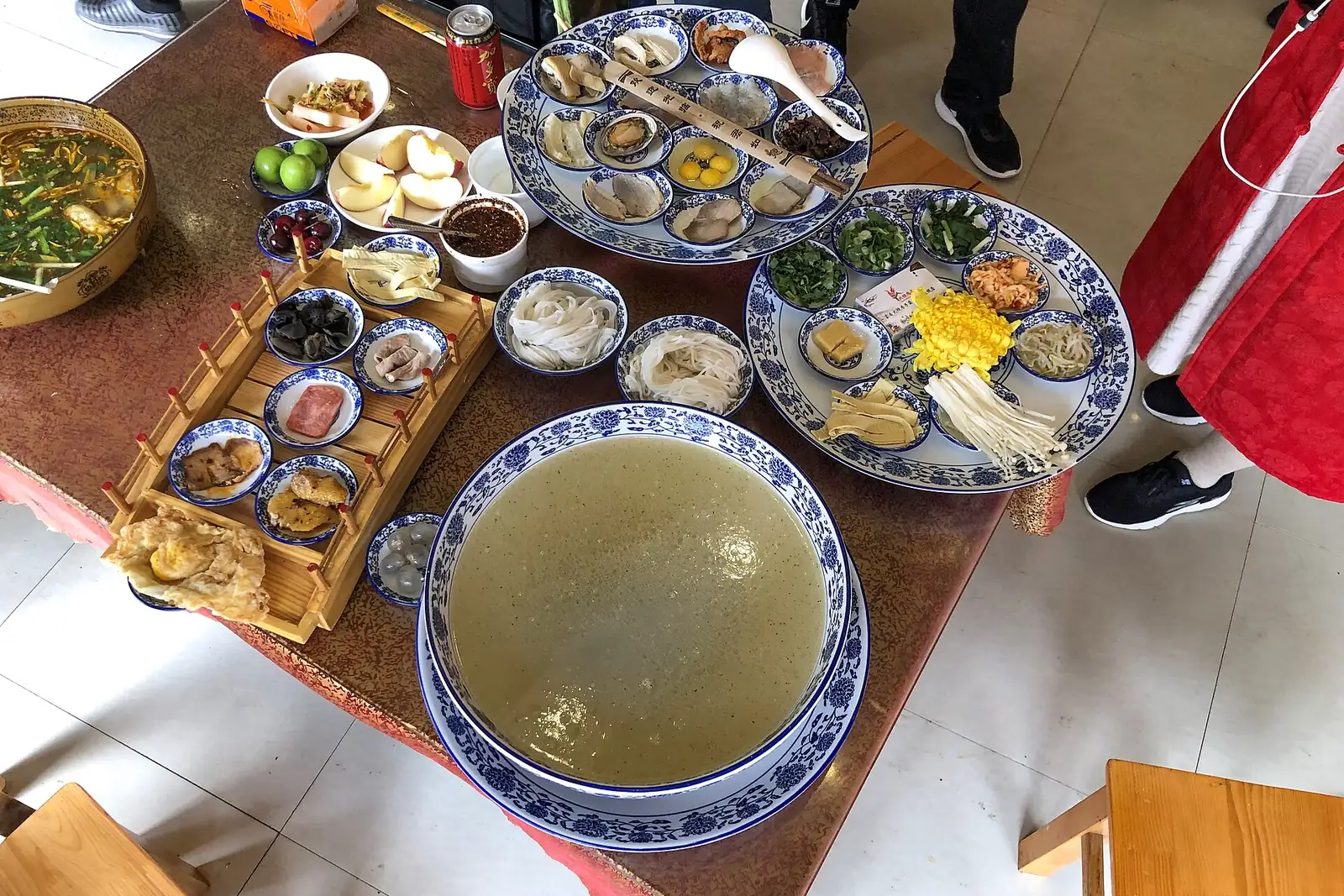
It actually comes from Mengzi, in southern Yunnan — not from Kunming itself. A bowl of scalding chicken broth, sealed under a layer of oil, arrives alongside raw sliced meats, vegetables and noodles that you slip in yourself, cooking them right at the table. In 2014 the Mengzi preparation technique was listed as part of China’s national intangible cultural heritage. For the story behind the name, see chapter six.
En realidad viene de Mengzi, en el sur de Yunnan, y no de Kunming. Llega un tazón de caldo de gallina hirviendo, sellado bajo una capa de grasa, junto con carnes crudas en láminas, verduras y fideos que uno mismo va echando para que se cuezan en la mesa. En 2014, la técnica de Mengzi entró en la lista nacional de patrimonio cultural inmaterial de China. La historia detrás del nombre está en el capítulo seis.
蒙自的一桌过桥米线:一大碗热汤,围着十几碟生鲜和小料。Crossing-the-bridge noodles in Mengzi: one great bowl of broth, ringed by plate after plate of things to cook in it.Fideos que cruzan el puente en Mengzi: un gran tazón de caldo rodeado de platito tras platito para cocer en él.图:Photo: Foto: N509FZ · CC BY-SA 4.0
米线的亲戚:饵丝与卷粉Mixian’s cousins: ersi and juanfenLos primos del mixian: ersi y juanfen
Like mixian, ersi are made from rice, but by a different road: the rice is soaked and steamed, then pounded and pressed into a firm rice cake, which is cut into fine ribbons. The result is chewier than mixian, with the fragrance of freshly steamed rice. Tengchong, in western Yunnan, is famous for it, and in Kunming a bowl of braised-pork or small-pot ersi is a breakfast staple.
The legend — a local story, not documented history: fleeing west at the end of the Ming dynasty, the Yongli Emperor was fed a plate of stir-fried rice cake at a farmhouse near Tengchong and hailed it as the dish that “came to the emperor’s rescue.” It is still called dà jiù jià today.
Como el mixian, el ersi se hace de arroz, pero por otro camino: el arroz se remoja y se cuece al vapor, luego se machaca y se prensa hasta formar un pastel firme, que se corta en tiras finas. Queda más masticable que el mixian y con aroma a arroz recién cocido. El más famoso es el de Tengchong, en el oeste de Yunnan, y en Kunming un tazón de ersi con cerdo estofado o de olla pequeña es un desayuno de siempre.
La leyenda (un relato local, no historia documentada): huyendo hacia el oeste al final de la dinastía Ming, el emperador Yongli comió un plato de pastel de arroz salteado en una granja cerca de Tengchong y lo llamó el plato que «rescató al emperador». Todavía hoy se le conoce como dà jiù jià.
Juanfen is another old friend of the Kunming breakfast table: rice batter steamed into thin sheets, rolled up and cut into lengths — sometimes wrapped around minced pork, wood-ear mushroom and bean sprouts, then dressed with a savory sauce. It is a cousin of Cantonese rice-noodle rolls, but heartier and more savory, often served with Yunnan pickles.
El juanfen es otro viejo conocido del desayuno en Kunming: una masa de arroz cocida al vapor en láminas finas, enrollada y cortada en trozos; a veces rellena de carne molida, hongo oreja y germen de soya, y bañada con una salsa sabrosa. Es pariente de los rollos de arroz cantoneses, pero más contundente y salado, y suele ir con encurtidos de Yunnan.
米线从哪里来Where mixian comes fromDe dónde viene el mixian
Yunnan has grown rice for thousands of years, from the flat paddies around Kunming’s Dian Lake to the Hani terraces of the Ailao Mountains — and where there is rice, there are cooks finding new things to do with it. Turning rice into slender strands is an old Chinese art: a sixth-century farming manual, the Qimin Yaoshu, describes rice-flour threads called can, and the Song-dynasty poet Chen Zao wrote of “rice cords,” fine as silk and dried to give as gifts. Nobody can name the year mixian arrived in Yunnan, but by the Ming and Qing dynasties it was, by most accounts, everyday food across central Yunnan.
En Yunnan se cultiva arroz desde hace miles de años, desde los arrozales llanos junto al lago Dian, en Kunming, hasta las terrazas de los hani en los montes Ailao; y donde hay arroz, hay cocineros buscándole usos nuevos. Convertir el arroz en hebras finas es un arte antiguo en China: un manual agrícola del siglo VI, el Qimin Yaoshu, describe unas hebras de harina de arroz llamadas can, y el poeta Chen Zao, de la dinastía Song, escribió sobre unos «cordones de arroz» finos como la seda que se secaban para regalar. Nadie sabe en qué año llegó el mixian a Yunnan, pero en tiempos de las dinastías Ming y Qing ya era, según casi todos los relatos, comida de todos los días en el centro de la provincia.
贰 · 第二章Chapter twoCapítulo dos
春城昆明Kunming, the Spring CityKunming, la Ciudad de la Primavera
天气常如二三月,花枝不断四时春。“Here the weather stays as mild as early spring; blossoms never leave the branch — it is spring in every season.”«Aquí el tiempo es siempre de comienzos de primavera; nunca faltan flores en las ramas: es primavera en las cuatro estaciones.»
The lines above are by Yang Shen, one of the great scholars of the Ming dynasty, who was banished to Yunnan for speaking his mind and spent most of his life there. One of his poems speaks of “the sights of the Spring City” — and Kunming’s nickname is generally traced back to him.
Los versos son de Yang Shen, uno de los grandes letrados de la dinastía Ming, desterrado a Yunnan por decir lo que pensaba, donde pasó la mayor parte de su vida. En uno de sus poemas aparece «la Ciudad de la Primavera», y se suele decir que de él le viene el apodo a Kunming.
Kunming’s endless spring is a gift of geography. The city sits in a mountain basin on the Yunnan–Guizhou Plateau, about 1,900 meters (6,200 feet) up — higher than Denver — yet at roughly the latitude of Miami. The altitude takes the edge off summer, the latitude keeps winter at bay. January days are often brilliantly sunny; in July the average temperature hovers around 20 °C (68 °F).
La eterna primavera de Kunming es un regalo de la geografía. La ciudad se asienta en un valle entre montañas, en la meseta de Yunnan-Guizhou, a unos 1900 metros de altura —más alto que Denver—, pero en una latitud muy al sur, más o menos la de Miami. La altura le quita el bochorno al verano; la latitud mantiene lejos el invierno. En enero los días suelen ser de sol radiante; en julio la temperatura media ronda los 20 °C (68 °F).
A quien venga de Medellín, de Cuernavaca o de Guatemala, todo esto le sonará conocido: allá también se habla de la «eterna primavera». Kunming es, a su manera, una prima lejana al otro lado del Pacífico.
So something is always in bloom. The camellia is Kunming’s city flower, at its best from late winter into spring — it is the flower in our logo. Spring brings cherry and crabapple blossom; winter brings clouds of gulls to Dian Lake. The weather has rubbed off on the people, too. Kunming moves at an unhurried pace: tea, a patch of sunshine, a bowl of noodles, and the day takes care of itself.
Por eso en esta ciudad siempre hay algo en flor. La camelia es la flor de Kunming y luce en su mejor momento entre el final del invierno y la primavera: es la flor de nuestro logo. La primavera trae los cerezos y los manzanos silvestres en flor; en invierno, nubes de gaviotas llegan al lago Dian. Y el clima se le ha pegado a la gente. En Kunming nadie anda con prisa: un té, un rato al sol, un tazón de fideos, y el día se acomoda solo.
叁 · 第三章Chapter threeCapítulo tres
两千年的昆明Two thousand years in KunmingDos mil años de Kunming
一座湖边的城,几度成为西南的中心。A city by a lake that, again and again, found itself at the center of China’s southwest.Una ciudad junto a un lago que, una y otra vez, se encontró en el centro del suroeste de China.
战国—西汉c. 4th–1st century BCSiglos IV a I a. C., aprox.
古滇国The lost kingdom of DianEl reino perdido de Dian
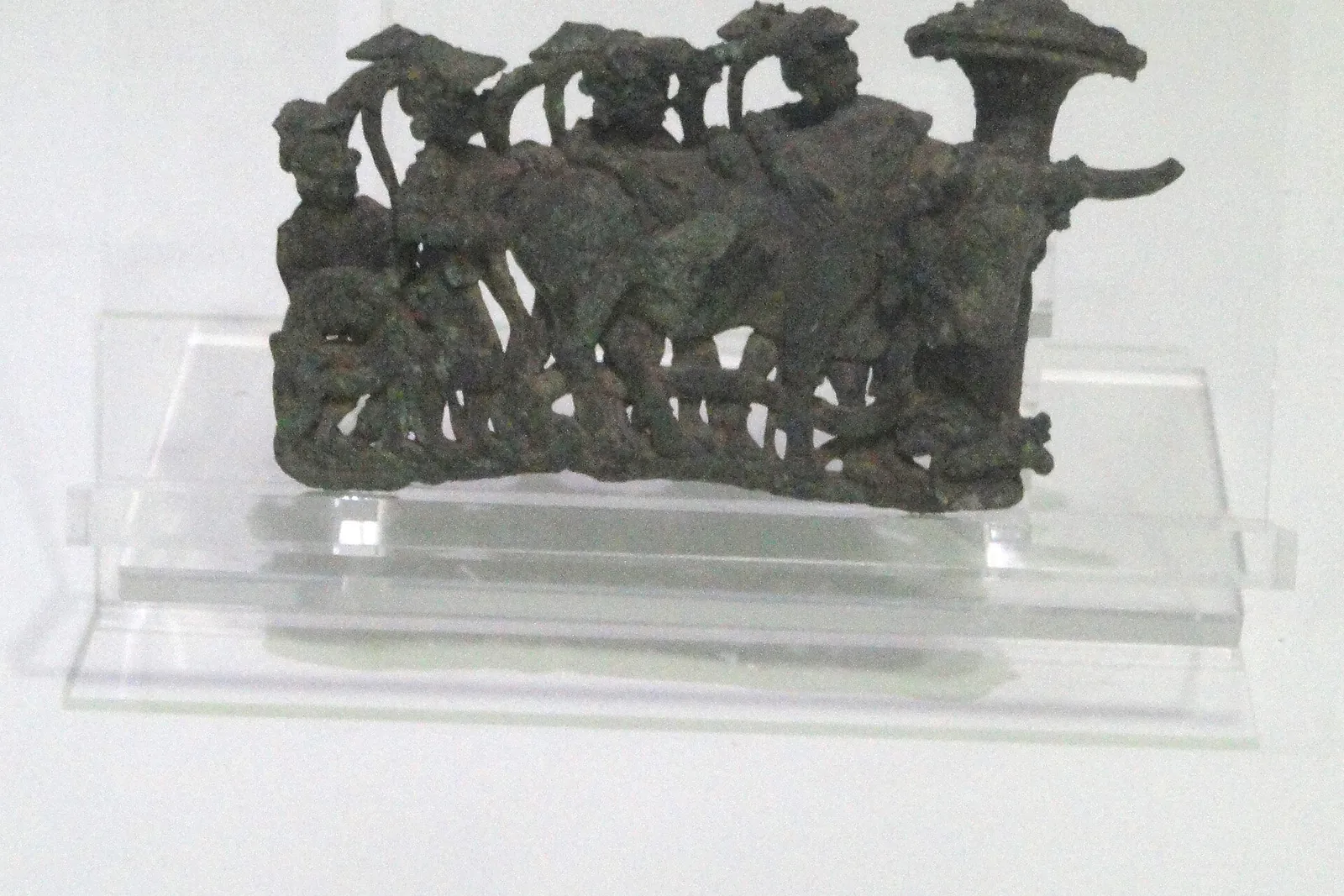
More than two thousand years ago, a bronze-casting kingdom called Dian flourished around the lake that still bears its name — “Dian” is Yunnan’s shorthand to this day. In 1956 archaeologists at Shizhaishan, on the lake’s southern shore, found a small gold seal reading “Seal of the King of Dian,” matching a line in the ancient Records of the Grand Historian about a royal seal granted by the Han emperor Wu.
Hace más de dos mil años, alrededor del lago que todavía lleva su nombre, floreció un reino de grandes fundidores de bronce llamado Dian; hasta hoy, «Dian» es la forma abreviada de decir Yunnan. En 1956, en Shizhaishan, en la orilla sur del lago, los arqueólogos encontraron un pequeño sello de oro con la inscripción «Sello del rey de Dian», que coincide con un pasaje de las antiguas Memorias históricas sobre el sello que el emperador Wu de la dinastía Han le concedió al rey.
西汉时期的滇国青铜扣饰,云南省博物馆藏。A bronze buckle ornament from the Dian kingdom, Western Han period. Yunnan Provincial Museum.Adorno de bronce del reino de Dian, época de los Han occidentales. Museo Provincial de Yunnan.图:Photo: Foto: Daderot · 公有领域Public domainDominio público
唐 · 约 765 年c. 765Hacia 765
筑城A city is foundedNace la ciudad
以洱海为中心的南诏国,在今天的昆明一带筑起「拓东城」,一般被视为昆明建城的开端。
The kingdom of Nanzhao, centered on Erhai Lake to the west, built a city called Tuodong on the site of today’s Kunming — usually counted as the city’s founding.
El reino de Nanzhao, con centro en el lago Erhai, al oeste, levantó una ciudad llamada Tuodong donde hoy está Kunming; se suele considerar la fundación de la ciudad.
The Yuan dynasty created the province of Yunnan, and its first governor, Sayyid Ajall Shams al-Din — a Muslim administrator from Central Asia, still fondly remembered — made Kunming his seat, building irrigation works and schools. Kunming has been Yunnan’s capital ever since.
La dinastía Yuan creó la provincia de Yunnan, y su primer gobernador, Sayyid Ajall Shams al-Din —un administrador musulmán de Asia Central al que todavía se recuerda con cariño—, puso su sede en Kunming y construyó obras de riego y escuelas. Desde entonces Kunming es la capital de Yunnan.
1909—1910 年1909–19101909-1910
讲武堂与米轨铁路A military academy and a railway to the seaUna academia militar y un tren hasta el mar
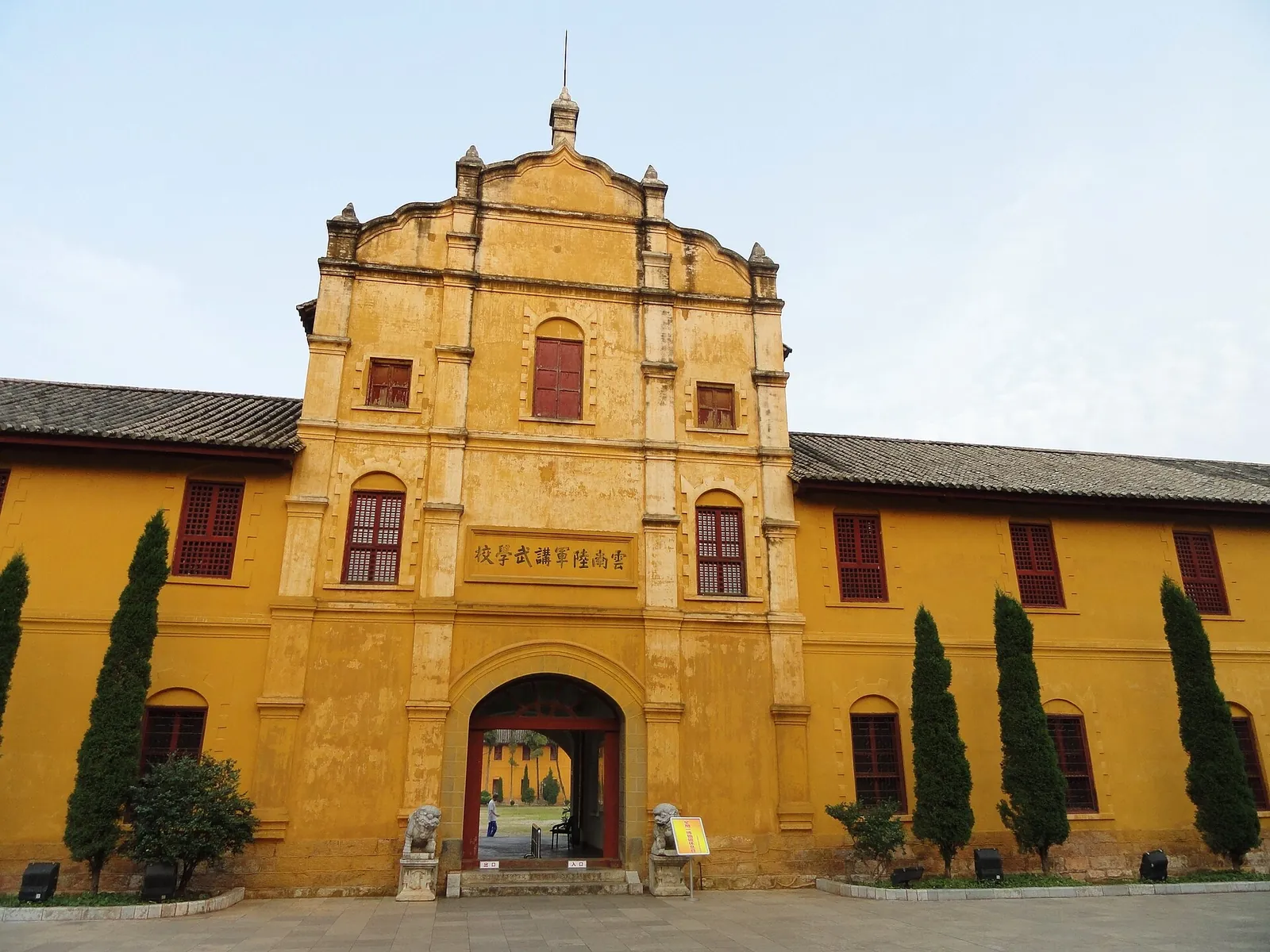
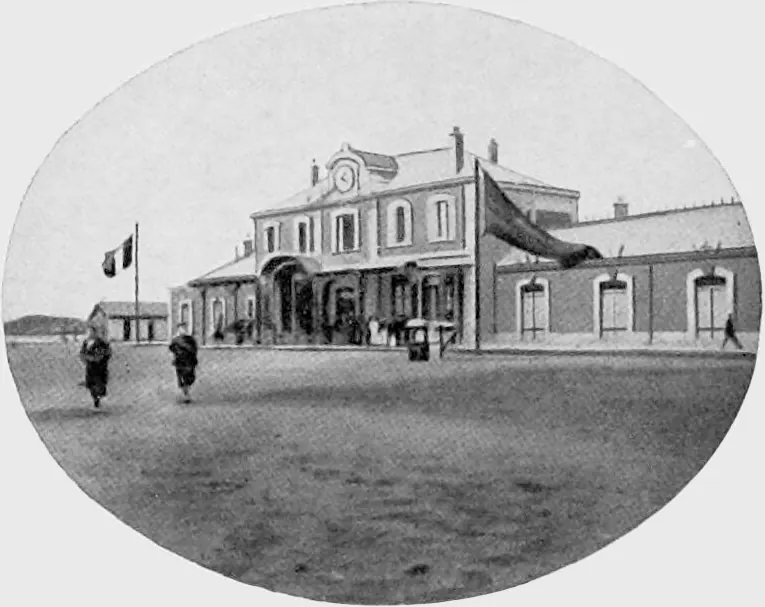
In 1909 the Yunnan Military Academy opened on the west bank of Green Lake; future marshals Zhu De and Ye Jianying studied or taught there. A year later a French-built narrow-gauge railway was finished, threading gorges and tunnels all the way south to the port of Haiphong, and bringing coffee, imported goods and French architecture to a plateau city.
En 1909 abrió la Academia Militar de Yunnan, en la orilla oeste del lago Verde; por ella pasaron, como alumnos o maestros, futuros mariscales como Zhu De y Ye Jianying. Un año después se terminó un ferrocarril de vía estrecha construido por los franceses que, entre gargantas y túneles, bajaba hasta el puerto de Haiphong y trajo café, mercancías importadas y arquitectura francesa a esta ciudad de altura.
云南陆军讲武堂旧址,就在翠湖西岸。The Yunnan Military Academy, on the west bank of Green Lake.La Academia Militar de Yunnan, en la orilla oeste del lago Verde.图:Photo: Foto: Daderot · 公有领域Public domainDominio público
1938—1946 年1938–19461938-1946
西南联大与飞虎队Wartime: a university in exile, and the Flying TigersLa guerra: una universidad en el exilio y los Tigres Voladores
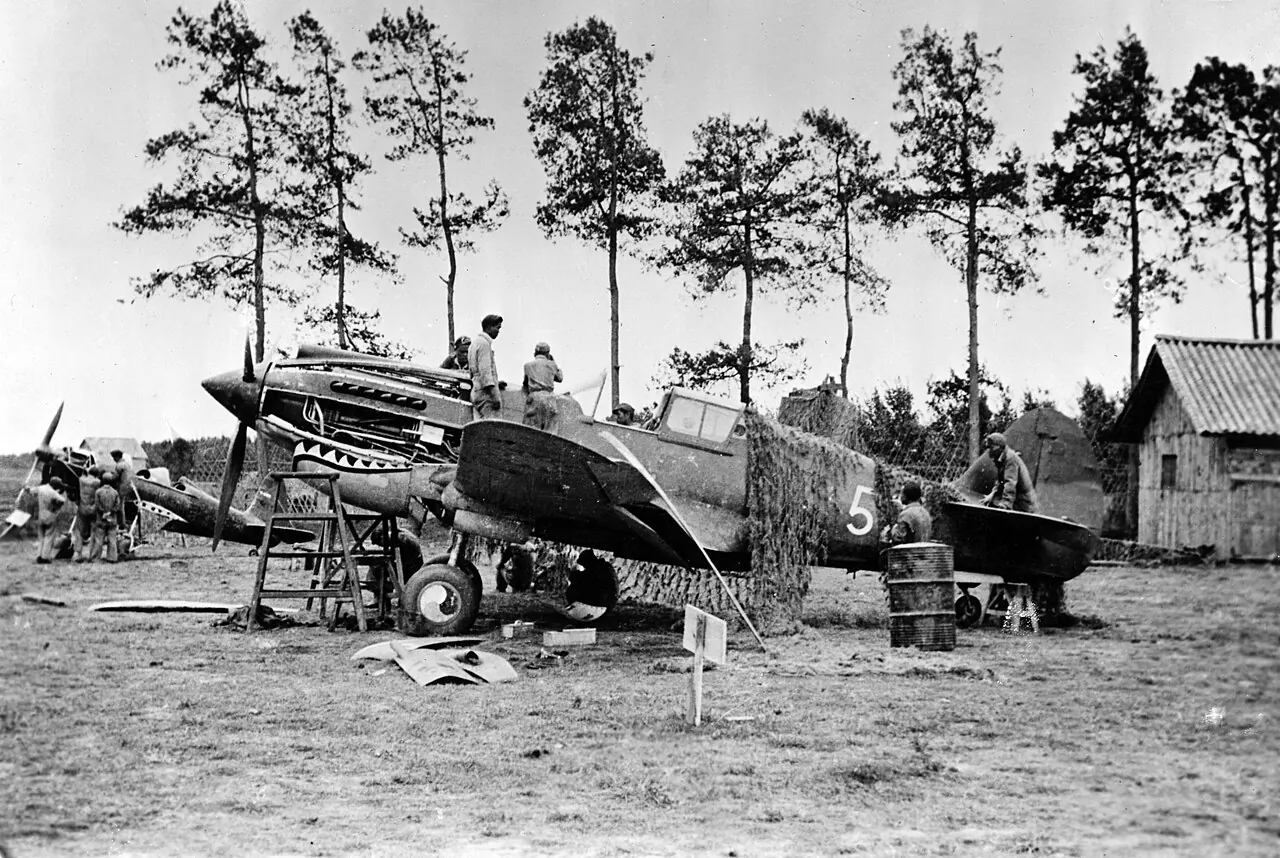
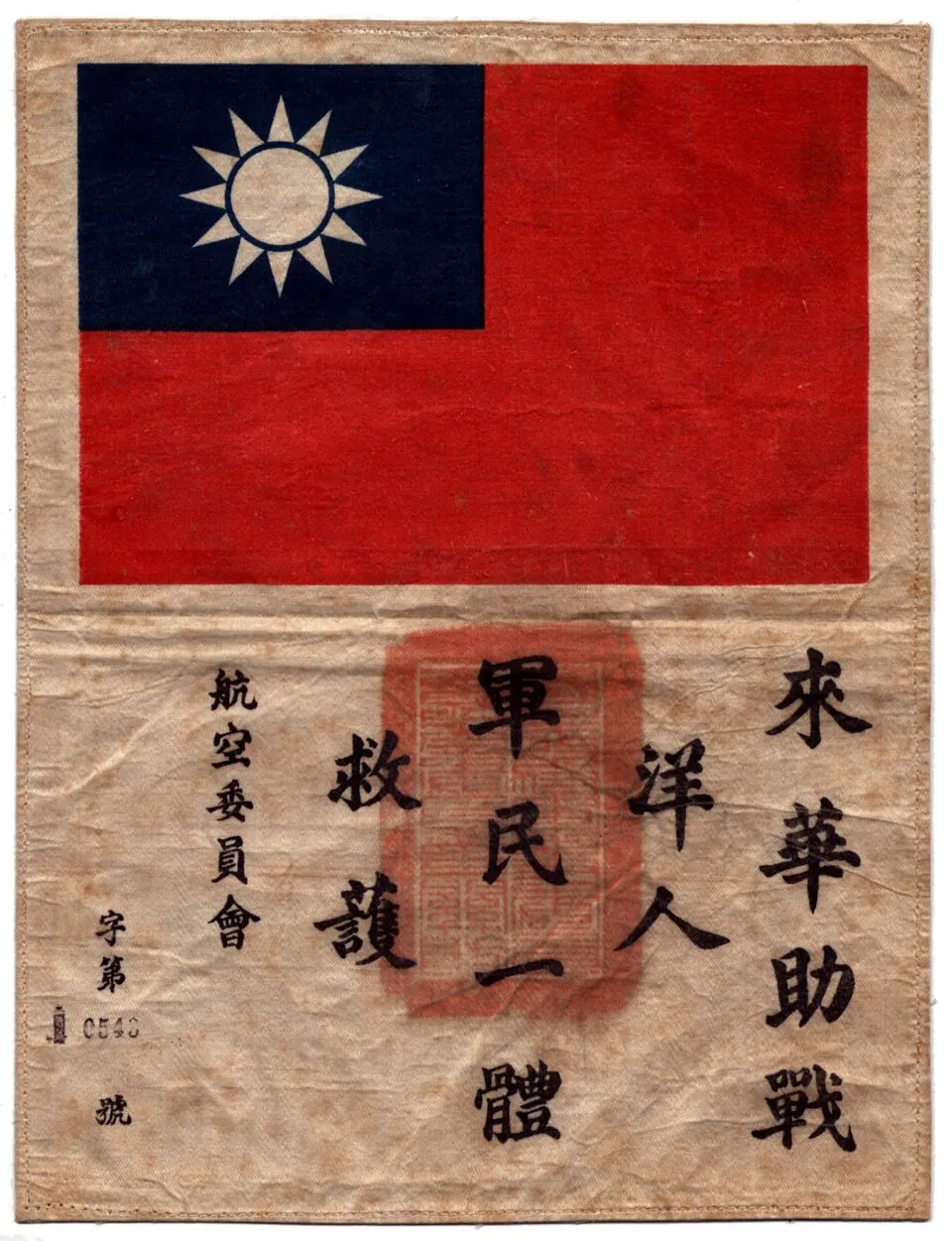
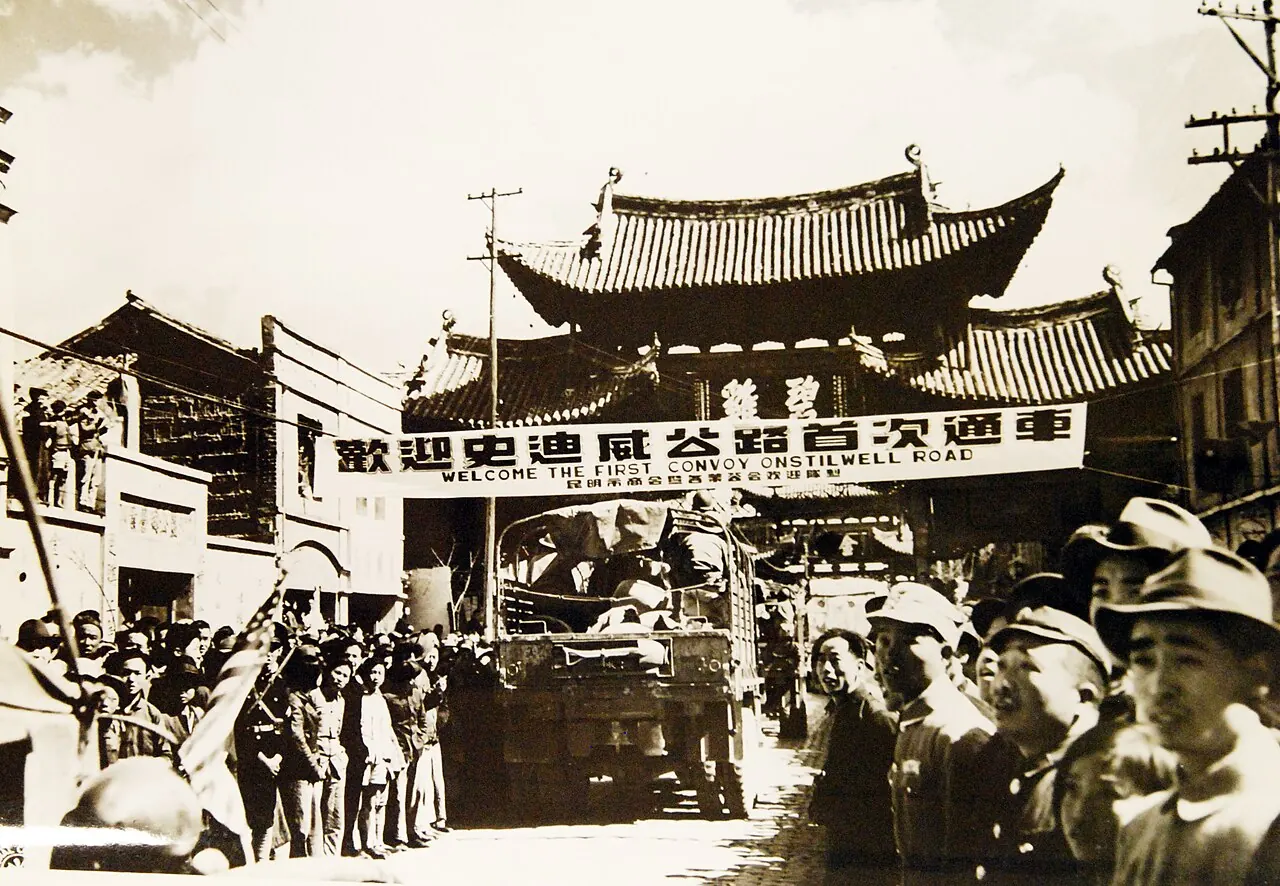
When war with Japan forced China’s great universities to flee, Peking, Tsinghua and Nankai regrouped in Kunming as the National Southwestern Associated University; in tin-roofed classrooms they educated a remarkable generation, including the Nobel physicists Chen-Ning Yang and Tsung-Dao Lee. At the same time Kunming was a key base for the American Volunteer Group — the Flying Tigers. Kunming has not forgotten: those American airmen are still remembered warmly here.
Cuando la guerra con Japón obligó a las grandes universidades chinas a huir, Pekín, Tsinghua y Nankai se reagruparon en Kunming como la Universidad Asociada del Suroeste; en aulas con techo de lámina formaron a una generación extraordinaria, entre ellos los premios Nobel de Física Chen-Ning Yang y Tsung-Dao Lee. En esos mismos años, Kunming fue una base clave del Grupo de Voluntarios Estadounidenses, los Tigres Voladores. Kunming no lo ha olvidado: a aquellos aviadores estadounidenses todavía se les recuerda con cariño.
肆 · 第四章Chapter fourCapítulo cuatro
在昆明走走Wandering KunmingPaseos por Kunming
如果你有机会去昆明,跟着我们从早走到晚。If you ever find yourself in Kunming, walk with us from morning to night.Si algún día va a Kunming, camine con nosotros de la mañana a la noche.
昆明城里走一圈A day’s walk through KunmingUn día a pie por Kunming
从清晨的翠湖走到夜里的古镇:十站,一天,一路有故事,一路也有吃的。卡片左右滑动,点「多一点」看传说。From Green Lake at dawn to an old lakeside town after dark: ten stops, one day, a story at every corner and something to eat along the way. Swipe through the cards; tap “A little more” for the legends.Del lago Verde al amanecer a un pueblo antiguo junto al lago ya de noche: diez paradas, un día, una historia en cada esquina y algo de comer por el camino. Deslice las tarjetas; toque «Un poco más» para las leyendas.
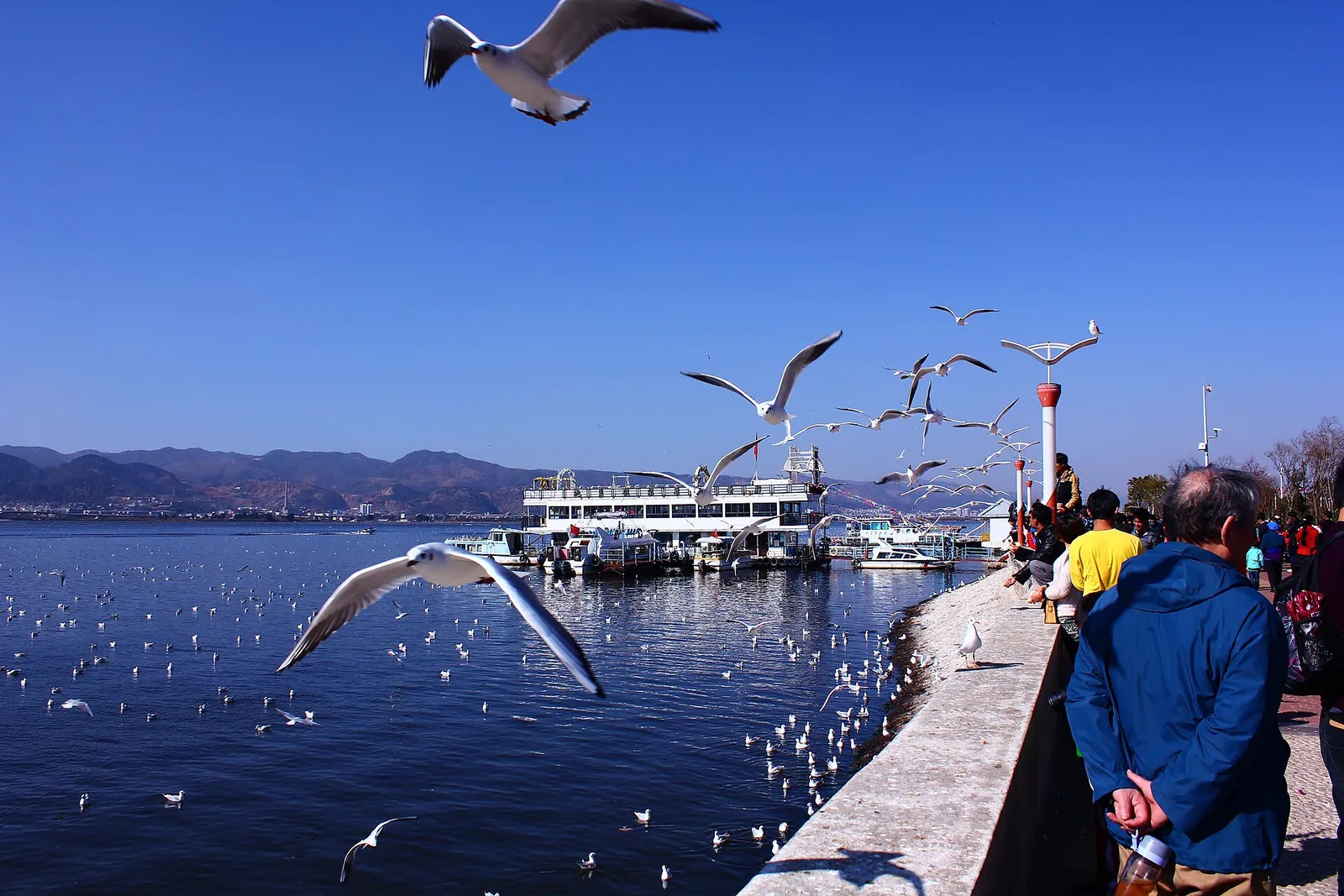
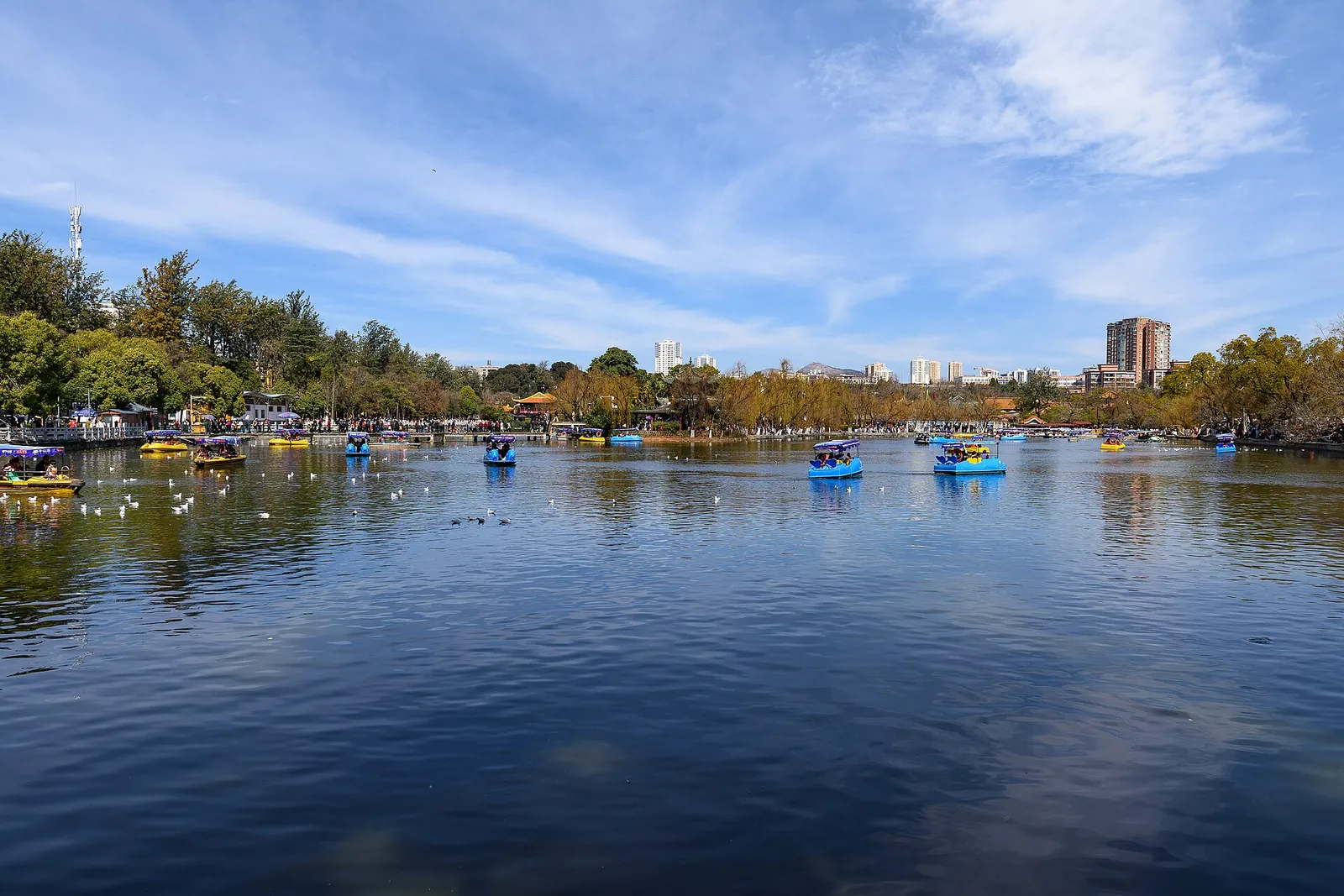
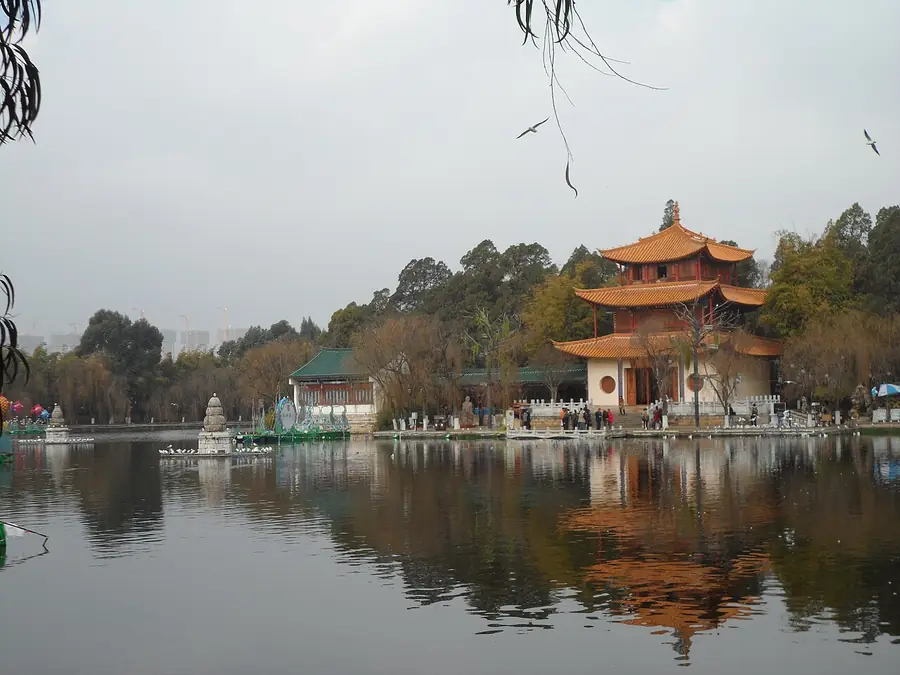
Green Lake at dawn is Kunming in miniature: someone warming up an opera aria, someone else doing tai chi or dancing. In winter, roughly November to March, black-headed gulls crowd the causeways and there are more people feeding them than watching.
El lago Verde al amanecer es Kunming en miniatura: alguien calentando la voz con un aria de ópera, otros haciendo taichí o bailando. En invierno, más o menos de noviembre a marzo, las gaviotas llenan las calzadas y hay más gente dándoles de comer que mirándolas.
附近吃:早饭就在湖边小巷里解决,一碗小锅米线,或者豆花米线。Nearby: breakfast in the lanes by the lake — a little-pot mixian, or mixian with silken tofu.Cerca: desayuno en los callejones del lago, un mixian de olla pequeña o con tofu sedoso.
On the west bank of the lake, a ring of yellow walls and colonnades encloses an old parade ground. Opened in 1909, this was one of modern China’s famous military schools — Zhu De and Ye Jianying studied or taught here. Today it is a museum.
En la orilla oeste del lago, un anillo de muros amarillos y galerías rodea un viejo patio de armas. Abierta en 1909, fue una de las academias militares más conocidas de la China moderna: aquí estudiaron o enseñaron Zhu De y Ye Jianying. Hoy es un museo.
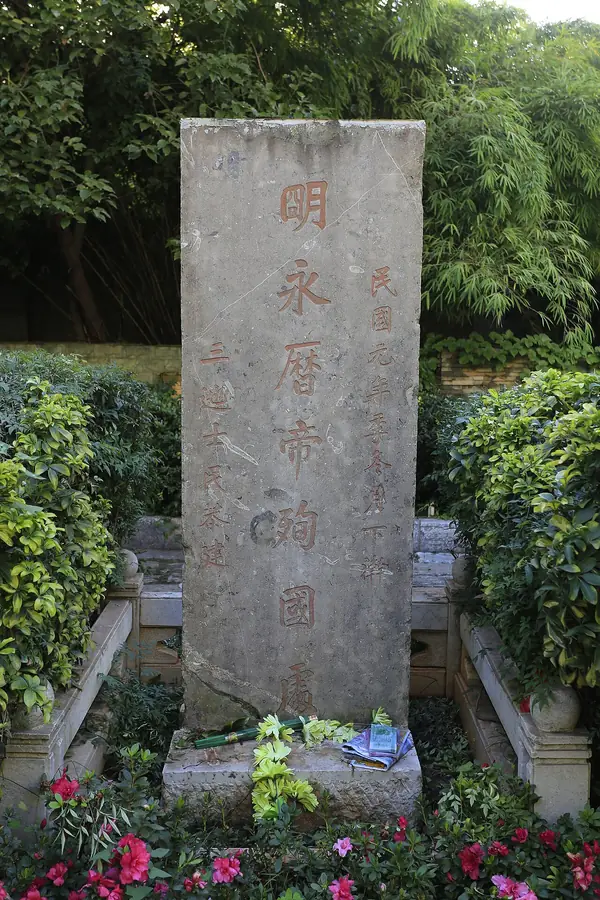
A short walk east of the lake, Huashan West Road climbs a steep little slope once called Bizi Po, “Comb Slope.” People came to call it Bisi Po — “the slope where he was driven to death.” In 1662 the Yongli Emperor, last ruler of the Southern Ming, was brought back from Burma as a captive and strangled near here on the orders of the general Wu Sangui.
A pocos pasos al este del lago, la calle Huashan Oeste sube por una cuesta empinada que antes se llamaba Bizi Po, «la cuesta del peine». La gente terminó llamándola Bisi Po, «la cuesta donde lo llevaron a la muerte». En 1662, el emperador Yongli, último soberano de los Ming del Sur, fue traído prisionero desde Birmania y estrangulado cerca de aquí por orden del general Wu Sangui.
In the early years of the Republic, General Cai E put up a stone here reading “Where the Ming Yongli Emperor died for his country,” signed in the name of “the people of Yunnan.” When the road was widened, the stone moved into a small garden beside it, where it still stands. What became of the emperor’s remains is disputed; legend says a loyal official carried them secretly back to Guizhou.
En los primeros años de la República, el general Cai E levantó aquí una estela que dice «Donde el emperador Yongli de los Ming murió por su país», firmada en nombre de «el pueblo de Yunnan». Al ensanchar la calle, la estela pasó a un jardincito al lado, donde sigue. Qué fue de los restos del emperador no está claro; se cuenta que un funcionario leal se los llevó en secreto a Guizhou.
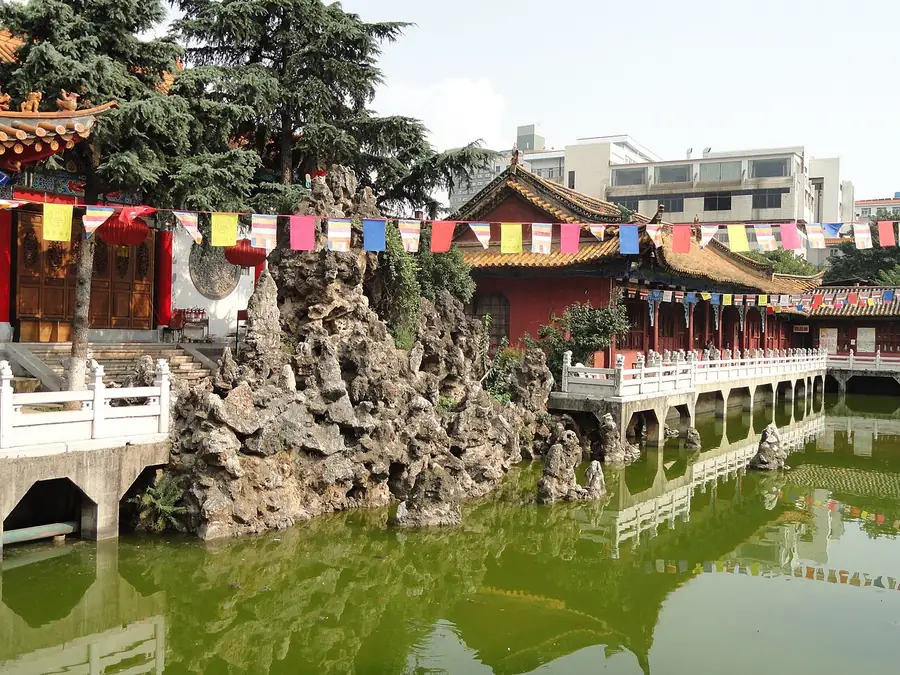
Yuantong Temple goes back more than twelve hundred years, to the Nanzhao kingdom. Its oddity is that it runs downhill: step through the gate and you descend into it, the whole temple spread out below you, the main hall standing in a green pool ringed by covered walkways.
El templo Yuantong tiene más de mil doscientos años, desde el reino de Nanzhao. Lo curioso es que va cuesta abajo: al cruzar la puerta se baja hacia él, con todo el templo extendido a los pies y la sala principal en medio de un estanque verde rodeado de galerías.
511:30
圆通山:樱花、动物园与英烈Yuantong Hill: blossoms, a zoo, and the fallenEl cerro Yuantong: flores, un zoológico y los caídos
Behind the temple rises Yuantong Hill, home to the Kunming Zoo since 1954. Around March the slopes turn pink with cherry and crabapple blossom — a long-time Kunming favorite for flower-gazing.
Detrás del templo se alza el cerro Yuantong, que desde 1954 alberga el zoológico de Kunming. Hacia marzo las laderas se cubren de cerezos y manzanos silvestres en flor: es el lugar de siempre de la gente de Kunming para ir a ver flores.
On the hill is the tomb of Tang Jiyao, who governed Yunnan for much of the early Republic and was one of the leaders of the 1915 National Protection War; it was finished in 1932, a round earthen mound faced with blue stone. At the summit stand two wartime memorials: one to the Chinese soldiers who fell in the 1942 Burma campaign, one to the Eighth Army men who died taking Songshan in western Yunnan in 1944.
En el cerro está la tumba de Tang Jiyao, que gobernó Yunnan buena parte de los primeros años de la República y fue uno de los líderes de la Guerra de Protección Nacional de 1915; se terminó en 1932, un túmulo redondo revestido de piedra azul. En la cima hay dos monumentos de guerra: uno a los soldados chinos caídos en la campaña de Birmania de 1942 y otro a los hombres del VIII Ejército que murieron tomando Songshan, en el oeste de Yunnan, en 1944.
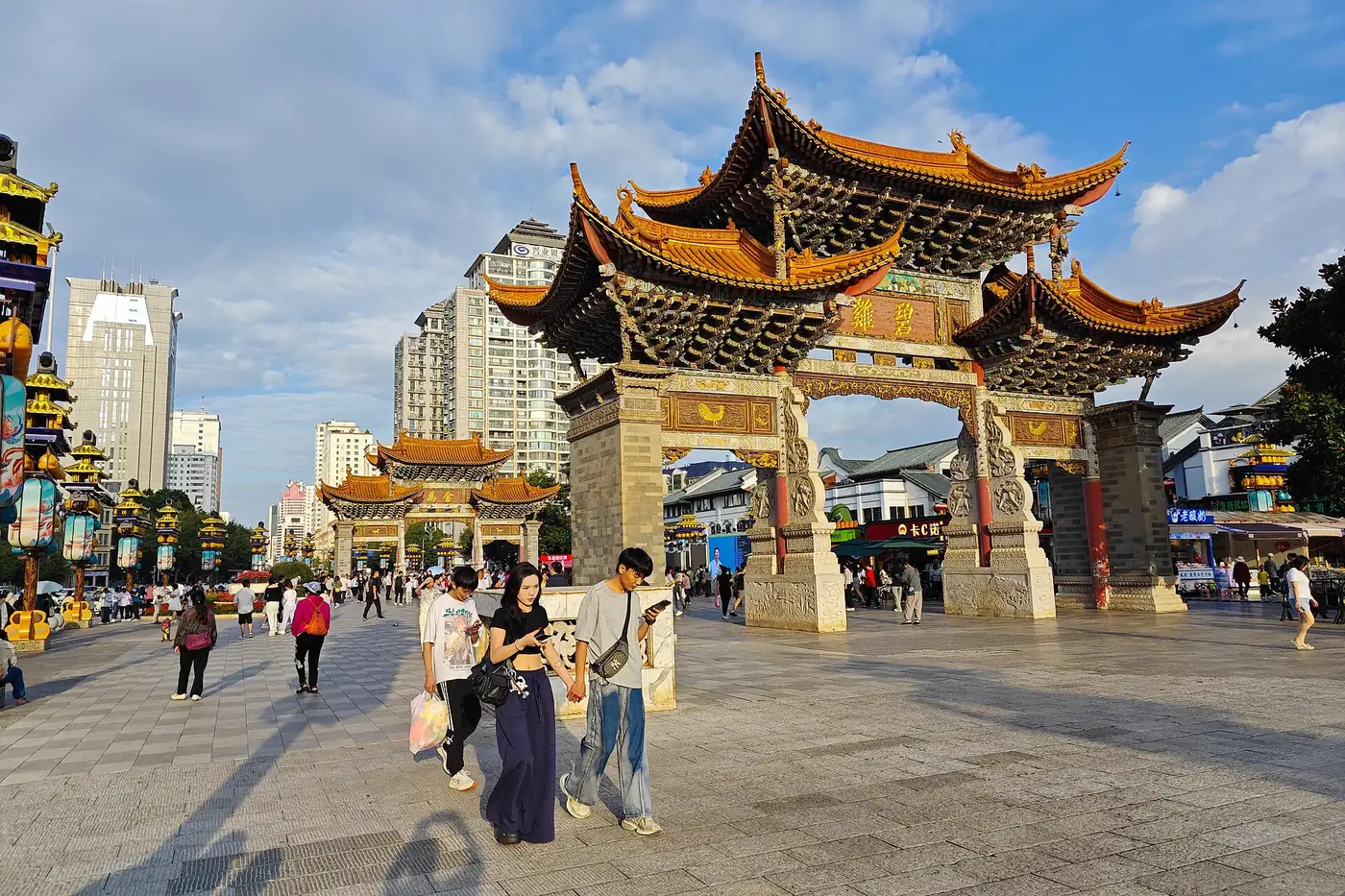
On Jinbi Road, two painted archways face each other: the Golden Horse to the east, the Jade Rooster to the west. The names come from an old legend about the hills on either side of the city — a golden horse said to gallop on the eastern hills, a green-feathered rooster said to crow on the western ones. First raised in the 1420s–30s, the arches have been destroyed and rebuilt several times; today’s pair dates from 1999.
En la calle Jinbi, dos arcos pintados se miran de frente: el del Caballo Dorado al este y el del Gallo de Jade al oeste. Los nombres vienen de una vieja leyenda de los cerros a ambos lados de la ciudad: dicen que en los del este galopaba un caballo dorado y en los del oeste cantaba un gallo de plumas verdes. Levantados por primera vez hacia 1430, los arcos se han destruido y reconstruido varias veces; los de hoy son de 1999.
多一点:金碧交辉A little more: when the shadows meetUn poco más: cuando las sombras se juntan
Old Kunming folk say that once every sixty years comes a day when the setting sun throws the Jade Rooster’s shadow east while the rising moon throws the Golden Horse’s shadow west, until the two shadows meet in the middle of the street — “gold and jade shining on each other.” Which day? Some say when the Mid-Autumn Festival falls on the autumn equinox; accounts differ, and no one has a reliable record of seeing it. It is the kind of romantic story a city tells itself.
Los viejos de Kunming cuentan que una vez cada sesenta años llega un día en que el sol poniente proyecta la sombra del Gallo de Jade hacia el este mientras la luna naciente proyecta la del Caballo Dorado hacia el oeste, hasta que las dos sombras se juntan en medio de la calle: «el oro y el jade brillando el uno sobre el otro». ¿Qué día? Hay quien dice que cuando la Fiesta de Medio Otoño coincide con el equinoccio; las versiones varían y nadie tiene un registro fiable de haberlo visto. Es el tipo de historia romántica que una ciudad se cuenta a sí misma.
The ancient Book of Han records that Emperor Xuan, hearing of the spirits of the golden horse and the jade rooster, sent the official Wang Bao to make offerings to them. Just north stands a third arch, honoring Sayyid Ajall, the Yuan-dynasty governor; together the three are laid out like the character 品.
El antiguo Libro de Han cuenta que el emperador Xuan, al oír hablar de los espíritus del caballo dorado y del gallo de jade, envió al funcionario Wang Bao a hacerles ofrendas. Justo al norte hay un tercer arco, en honor de Sayyid Ajall, el gobernador de la dinastía Yuan; los tres forman la figura del carácter 品.
附近吃:牌坊往北就是老城的商业街区,烧饵块、烤豆腐,边走边吃。Nearby: north of the arches lies the old shopping district — grilled rice cakes and charcoal-grilled tofu to eat as you walk.Cerca: al norte de los arcos está el viejo barrio comercial, con tortas de arroz a la parrilla y tofu asado al carbón para comer caminando.
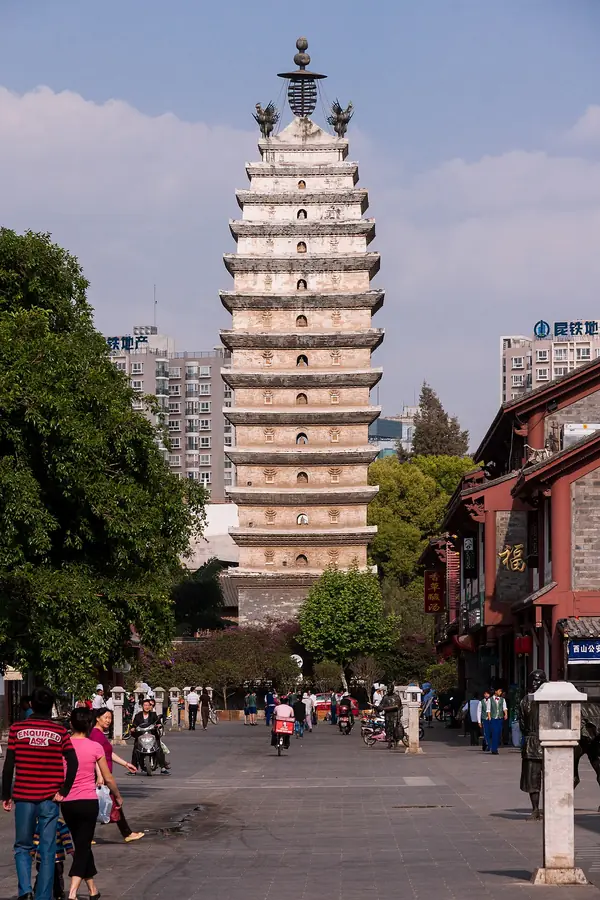
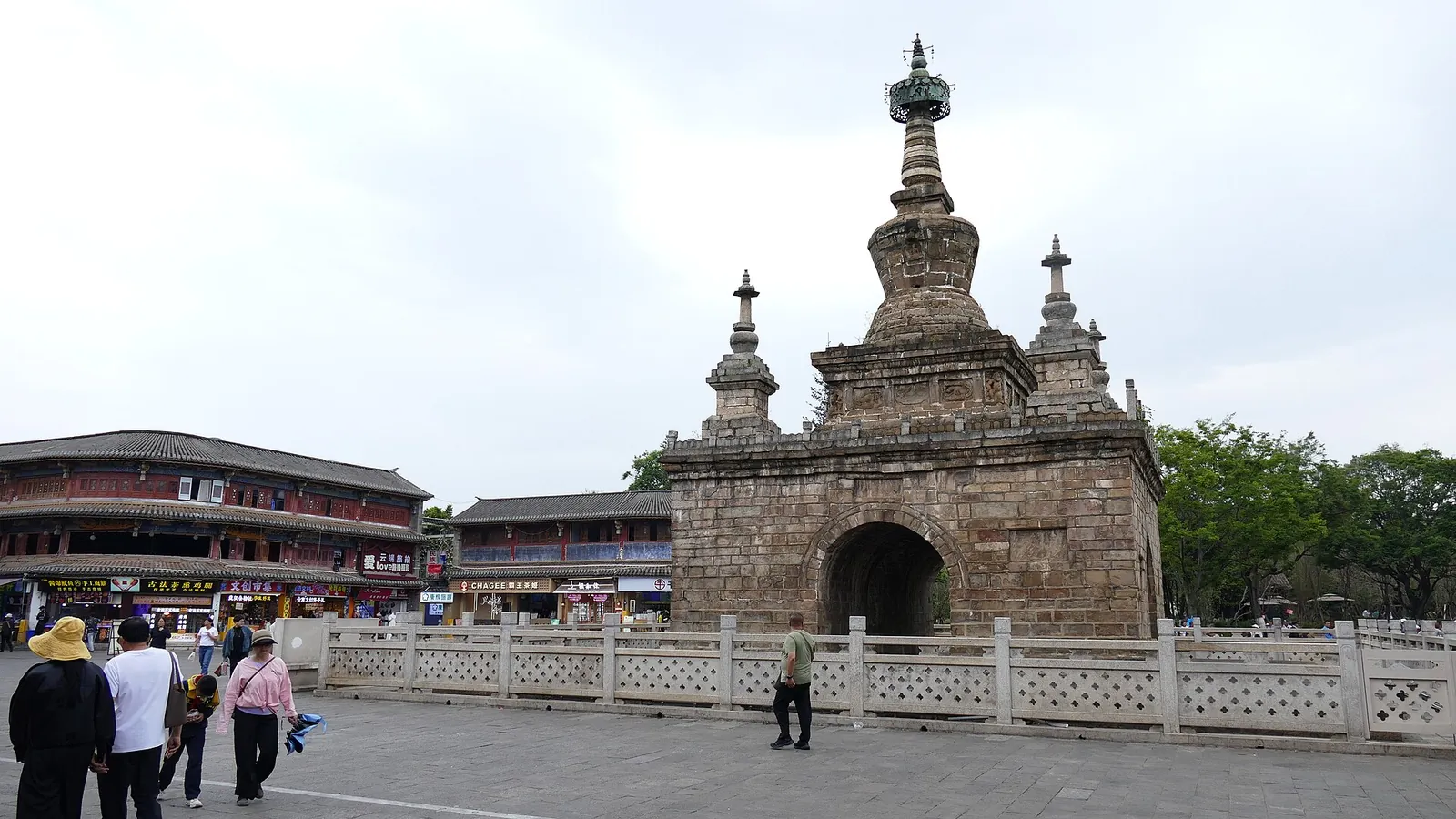
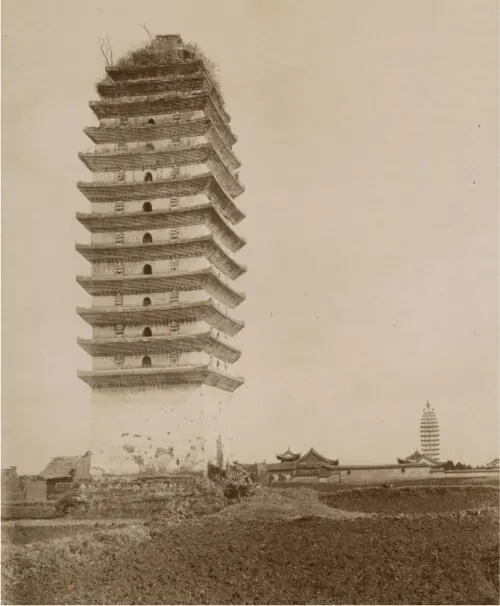
A few steps further south, two thirteen-tiered brick pagodas from the Nanzhao kingdom stand a short way apart, east and west — five or six centuries older than the arches. Bronze roosters perch on the corners of each top; legend says the East Pagoda’s birds held whistles and would “crow” whenever the southwest wind blew. The East Pagoda fell in the great earthquake of 1833 and was rebuilt on a new site in 1883.
Unos pasos más al sur, dos pagodas de ladrillo de trece pisos del reino de Nanzhao se alzan a poca distancia, una al este y otra al oeste, cinco o seis siglos más antiguas que los arcos. En las esquinas de cada remate hay gallos de bronce; se cuenta que los de la pagoda del Este llevaban silbatos dentro y «cantaban» cuando soplaba el viento del suroeste. La del Este se derrumbó en el gran terremoto de 1833 y se reconstruyó en otro sitio en 1883.
附近吃:塔下的老街坐一坐,喝杯茶歇歇脚。Nearby: sit down in the old street below the pagoda for a cup of tea and a rest.Cerca: siéntese en la calle vieja al pie de la pagoda a tomar un té y descansar.
In the afternoon head southwest to Daguan Pavilion on the north shore of Dian Lake. On its pillars hangs a couplet by the 18th-century scholar Sun Ranweng: 180 characters in all, often called the longest couplet under heaven. It opens, “Five hundred li of Dian Lake come rushing before my eyes” — and you look up, and there the water is.
Por la tarde, hacia el suroeste, al pabellón Daguan en la orilla norte del lago Dian. En sus columnas cuelga un pareado del letrado Sun Ranweng, del siglo XVIII: 180 caracteres en total, al que a menudo llaman el pareado más largo bajo el cielo. Empieza: «Quinientos li del lago Dian vienen corriendo ante mis ojos», y uno levanta la vista y ahí está el agua.
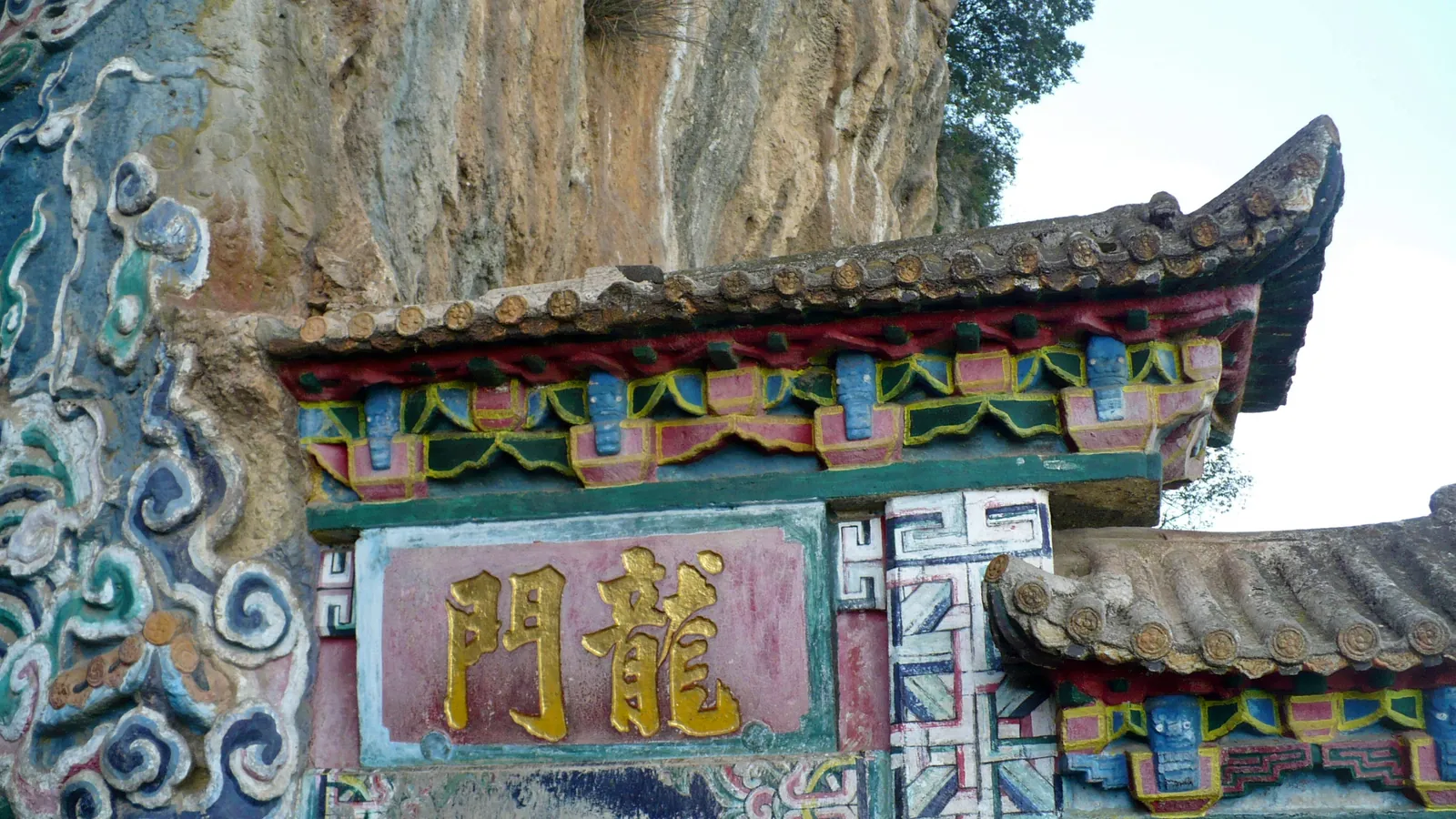
Toward evening, climb the Western Hills to the Dragon Gate, cut into the cliff over seventy-two years and three generations from 1781. The sun drops behind the hill at your back, and the whole lake below slowly turns to gold.
Al caer la tarde, suba a los Montes del Oeste hasta la Puerta del Dragón, tallada en el acantilado durante setenta y dos años y tres generaciones a partir de 1781. El sol se esconde detrás del cerro, a su espalda, y todo el lago, abajo, se va volviendo dorado.
After dark, swing round to Guandu on the lake’s northeast shore, once a ferry landing. Beneath its Ming-dynasty pagoda, the lamps come on in the old lanes and the stalls come alive.
Ya de noche, dé la vuelta hasta Guandu, en la orilla noreste del lago, antiguo embarcadero. Al pie de su pagoda de la dinastía Ming se encienden las luces de los callejones y los puestos cobran vida.
附近吃:这一天的最后一口,留给一块刚出锅的官渡粑粑,或者一碗热米线。Nearby: save the day’s last bite for a Guandu griddle cake straight off the pan, or a hot bowl of mixian.Cerca: deje el último bocado del día para un pan a la plancha de Guandu recién hecho, o un tazón de mixian bien caliente.
时间只是建议,景点开放时间以当地为准。传说均已注明「相传」。Times are only a suggestion; check local opening hours. Legends are marked as legends.Los horarios son solo una sugerencia; consulte los horarios locales. Las leyendas están señaladas como tales.
1940 年代的昆明:点一点老地图Kunming in the 1940s: a map you can tapKunming en los años cuarenta: un mapa para tocar
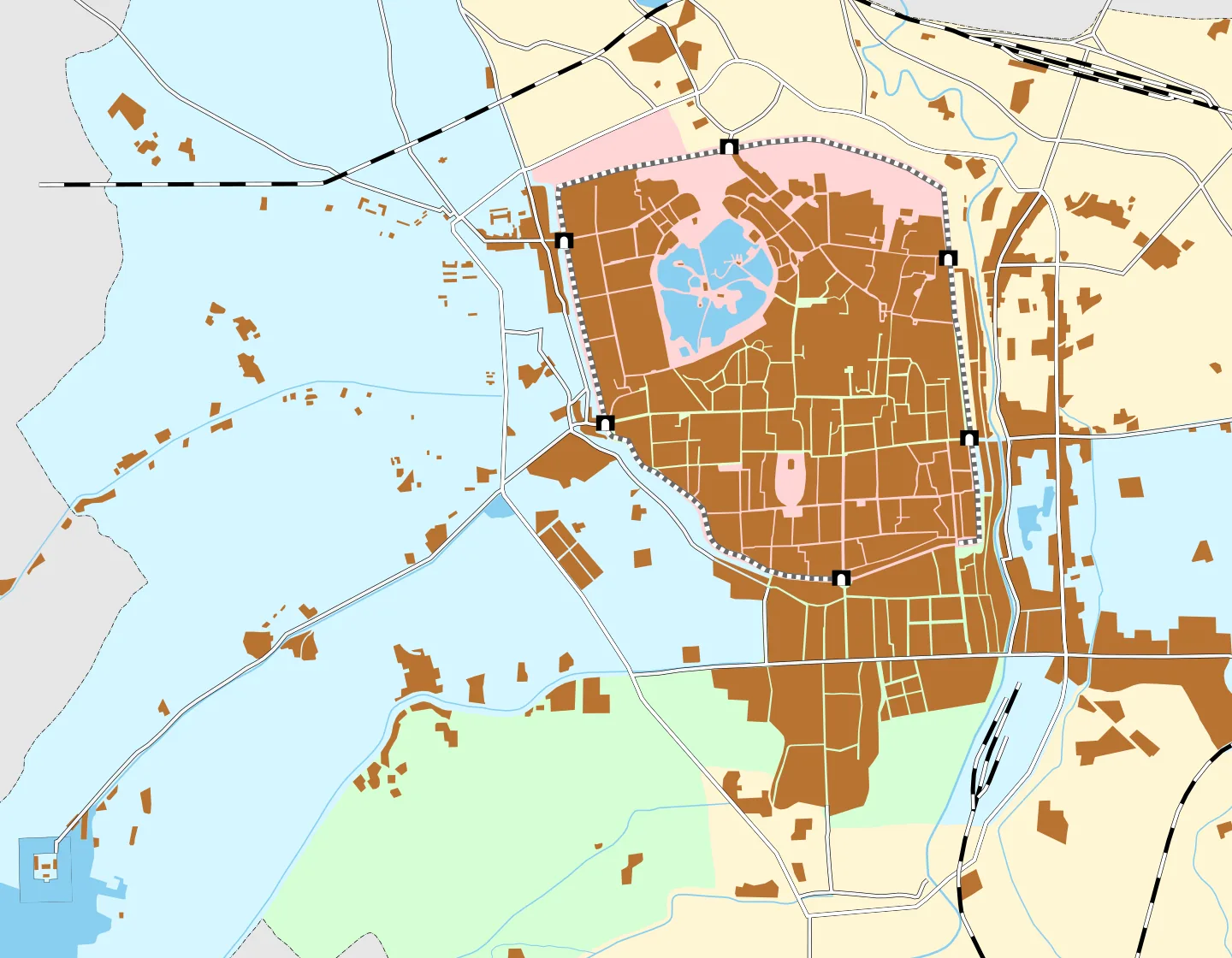
这是西南联大和飞虎队那几年的昆明。地图根据 1942 年 10 月昆明市政工务局的《昆明市区详图》重绘:棕色是房屋街区,黑白相间的线是城墙,粗虚线是铁路。点一点红色的号码,看看「城里走一圈」的各站当年在哪儿。This is Kunming in the years of the wartime university and the Flying Tigers. The map is redrawn from the city’s official street plan of October 1942: brown blocks are houses and streets, the black-and-white line is the city wall, and the heavy dashed lines are railways. Tap the red numbers to see where the stops on our walk stood back then.Así era Kunming en los años de la universidad en guerra y de los Tigres Voladores. El mapa está redibujado a partir del plano oficial de la ciudad de octubre de 1942: los bloques marrones son casas y calles, la línea blanca y negra es la muralla y las líneas discontinuas gruesas son los ferrocarriles. Toque los números rojos para ver dónde estaban entonces las paradas de nuestro paseo.
N ↑
1 km
← 左右滑动看全图 →← swipe to see the whole map →← deslice para ver todo el mapa →
翠湖Green LakeEl lago Verde
城墙里西北角的这片水就是翠湖。1940 年代街巷一直挤到湖边;今天的翠湖公园还在原处,是「城里走一圈」的第一站。The water in the north-west corner of the walled city is Green Lake. In the 1940s streets and lanes crowded right up to its banks; Green Lake Park is still in the same place today, and it is the first stop on our walk.El agua de la esquina noroeste de la ciudad amurallada es el lago Verde. En los años cuarenta las calles y los callejones llegaban hasta su orilla; el parque del lago Verde sigue en el mismo lugar y es la primera parada de nuestro paseo.
云南陆军讲武堂Yunnan Military AcademyAcademia Militar de Yunnan
翠湖西岸。1909 年开办的讲武堂是中国近代著名的军校,朱德、叶剑英都在这里学习或任教过;如今是博物馆。On the west shore of Green Lake. Opened in 1909, the academy was one of modern China’s best-known military schools; Zhu De and Ye Jianying studied or taught here. Today it is a museum.En la orilla oeste del lago Verde. Abierta en 1909, fue una de las escuelas militares más conocidas de la China moderna; Zhu De y Ye Jianying estudiaron o enseñaron aquí. Hoy es un museo.
翠湖往东,今天华山西路上的一段陡坡。1662 年,南明最后一位皇帝永历帝被从缅甸押回昆明,就在这一带被吴三桂下令缢杀;民国初年,蔡锷在坡边立了「明永历帝殉国处」石碑。East of Green Lake, a steep stretch of today’s Huashan West Road. In 1662 Yongli, the last emperor of the Southern Ming, was brought back from Burma and put to death near here on Wu Sangui’s orders; in the early years of the Republic, Cai E set up a stone to mark the place.Al este del lago Verde, un tramo empinado de la actual calle Huashan Oeste. En 1662, Yongli, el último emperador de los Ming del Sur, fue traído de vuelta desde Birmania y ejecutado cerca de aquí por orden de Wu Sangui; en los primeros años de la República, Cai E levantó una estela para señalar el lugar.
圆通寺与圆通山Yuantong Temple and HillEl templo y el cerro Yuantong
北城墙内侧的圆通山,山脚是南诏时期始建的圆通寺。1954 年起山上成了昆明动物园,每年三月前后樱花开满山坡。Just inside the north wall rises Yuantong Hill, with Yuantong Temple, founded in the Nanzhao era, at its foot. Since 1954 the hill has been the Kunming Zoo, and around March its slopes are covered in cherry blossom.Justo dentro de la muralla norte se alza el cerro Yuantong, con el templo Yuantong, fundado en la época de Nanzhao, a sus pies. Desde 1954 el cerro es el zoológico de Kunming, y hacia marzo sus laderas se llenan de cerezos en flor.
金马碧鸡坊Golden Horse & Jade Rooster ArchesArcos del Caballo Dorado y el Gallo de Jade
南城门外的金碧路上,金马、碧鸡两座牌坊隔街相望。牌坊几毁几建,今天看到的是 1999 年重建的。Outside the south gate, on Jinbi Road, the Golden Horse and Jade Rooster arches face each other across the street. They have been destroyed and rebuilt more than once; the arches you see today date from 1999.Fuera de la puerta sur, en la calle Jinbi, los arcos del Caballo Dorado y del Gallo de Jade se miran de un lado a otro de la calle. Se han destruido y reconstruido más de una vez; los que se ven hoy son de 1999.
东寺塔与西寺塔East and West PagodasPagodas del Este y del Oeste
再往南,两座南诏时期的砖塔一东一西。东寺塔在 1833 年的大地震里倒塌,1883 年在新址重建——所以这张 1942 年的地图上,它已经站在今天的位置。Farther south stand two brick pagodas from the Nanzhao era, one east and one west. The East Pagoda fell in the earthquake of 1833 and was rebuilt on a new site in 1883 — so on this 1942 map it already stands where it stands today.Más al sur se levantan dos pagodas de ladrillo de la época de Nanzhao, una al este y otra al oeste. La del Este se derrumbó en el terremoto de 1833 y se reconstruyó en otro lugar en 1883; por eso, en este mapa de 1942, ya está donde está hoy.
城西南、滇池北岸的大观楼,门柱上挂着孙髯翁的一百八十字长联。地图左下角水边围起来的那块园子,就是大观公园一带。South-west of the city, on the north shore of Dian Lake: Daguan Pavilion, with Sun Ranweng’s 180-character couplet on its pillars. The enclosed garden by the water at the lower left of the map is the Daguan Park area.Al suroeste de la ciudad, en la orilla norte del lago Dian: el pabellón Daguan, con el pareado de 180 caracteres de Sun Ranweng en sus columnas. El jardín cercado junto al agua, abajo a la izquierda del mapa, es la zona del parque Daguan.
西南联大Southwestern Associated UniversityUniversidad Asociada del Suroeste
城墙西北外。1938 年到 1946 年,北大、清华、南开南迁昆明,合组为西南联合大学,校舍就在这一带。铁皮屋顶的教室里,走出了杨振宁、李政道等一大批人才。Outside the north-west corner of the wall. From 1938 to 1946 Peking, Tsinghua and Nankai universities, driven south by the war, taught together here as the National Southwestern Associated University. Its tin-roofed classrooms educated a remarkable generation, including the physicists Chen-Ning Yang and Tsung-Dao Lee.Fuera de la esquina noroeste de la muralla. De 1938 a 1946, las universidades de Pekín, Tsinghua y Nankai, desplazadas al sur por la guerra, enseñaron juntas aquí como la Universidad Asociada del Suroeste. En sus aulas con techo de lámina se formó una generación extraordinaria, entre ellos los físicos Chen-Ning Yang y Tsung-Dao Lee.
城墙与城门The city wall and gatesLa muralla y sus puertas
图上黑白相间的线是城墙,黑色小方块是城门;南城墙东段 1938 年已经拆了。如今城墙早已不在,只在「小西门」「北门街」这样的地名里还留着它的影子。The black-and-white line is the city wall, and the small black squares are its gates; the eastern part of the south wall had already come down in 1938. The wall is long gone now. It lives on only in place names such as Xiaoximen, “Lesser West Gate,” and Beimen Jie, “North Gate Street.”La línea blanca y negra es la muralla, y los cuadraditos negros son sus puertas; el tramo este de la muralla sur ya se había derribado en 1938. Hoy la muralla ya no existe. Solo sobrevive en nombres de lugares como Xiaoximen, «Puerta Oeste Menor», y Beimen Jie, «calle de la Puerta Norte».
西山龙门Dragon Gate, Western HillsPuerta del Dragón
隔着滇池,在城西南,图外across Dian Lake to the south-west, off the mapal otro lado del lago Dian, al suroeste, fuera del mapa
西山在滇池西岸,从这张图的左下方再往外走。悬崖上的龙门 1781 年起凿,三代人凿了七十二年;傍晚站在那儿,看整片滇池慢慢变成金色。The Western Hills rise on the far shore of Dian Lake, beyond the lower left corner of this map. Work on the Dragon Gate, cut into the cliff face, began in 1781 and took three generations, seventy-two years. Stand there at sunset and watch the whole lake turn gold.Los Montes del Oeste se alzan en la otra orilla del lago Dian, más allá de la esquina inferior izquierda del mapa. La Puerta del Dragón, tallada en el acantilado, se empezó en 1781 y llevó tres generaciones, setenta y dos años. Al atardecer, desde allí se ve todo el lago volverse dorado.
城东南约 6 公里,图外about 6 km south-east, off the mapa unos 6 km al sureste, fuera del mapa
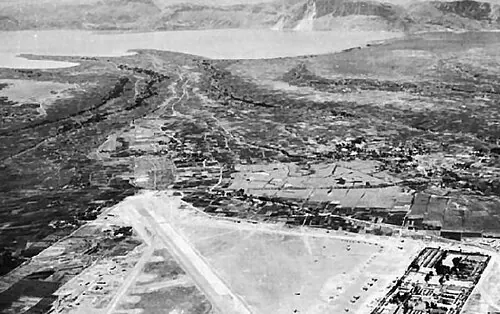
巫家坝机场在城东南约 6 公里,这张图的右下方之外。1941 年起,飞虎队就以这里为家,从这里起飞保卫昆明的天空。Wujiaba airfield lay about 6 km south-east of the city, beyond the lower right corner of this map. From 1941 it was home to the Flying Tigers, who took off from here to defend the skies over Kunming.El aeródromo de Wujiaba estaba a unos 6 km al sureste de la ciudad, más allá de la esquina inferior derecha del mapa. Desde 1941 fue el hogar de los Tigres Voladores, que despegaban de aquí para defender el cielo de Kunming.
城东南约 10 公里,图外about 10 km south-east, off the mapa unos 10 km al sureste, fuera del mapa
官渡古镇在滇池东北岸,城东南约 10 公里,曾是湖边的渡口。「城里走一圈」的最后一站:明代金刚塔下吃一块官渡粑粑。Guandu, once a ferry landing on the north-east shore of Dian Lake, lies about 10 km south-east of the old city. It is the last stop on our walk: a Guandu griddle cake beneath its Ming-dynasty pagoda.Guandu, antiguo embarcadero en la orilla noreste del lago Dian, está a unos 10 km al sureste de la ciudad vieja. Es la última parada de nuestro paseo: una torta de Guandu al pie de su pagoda de la dinastía Ming.
地标位置是按今天的经纬度换算到老地图上的,误差大约一两百米;逼死坡只标大致位置。地图:维基共享资源用户「瑞丽江的河水」据 1942 年《昆明市区详图》重绘,Landmarks were placed by converting today’s coordinates onto the old map, so allow a margin of a block or two; Bisi Slope is approximate. Map: redrawn by Wikimedia Commons user 瑞丽江的河水 from the 1942 Kunming street plan, Los lugares se situaron convirtiendo las coordenadas actuales al mapa antiguo, así que pueden desviarse una o dos cuadras; la cuesta Bisi es aproximada. Mapa: redibujado por el usuario de Wikimedia Commons 瑞丽江的河水 a partir del plano de Kunming de 1942, Wikimedia Commons · CC BY-SA 4.0;本站裁切、转为 WebP,并加注地标。; cropped, converted to WebP and annotated by us.; recortado, convertido a WebP y anotado por nosotros.
再走远一点A little farther outUn poco más lejos
冬天的滇池,红嘴鸥从西伯利亚飞来过冬。Winter on Dian Lake, when the gulls fly in from Siberia.Invierno en el lago Dian, cuando llegan las gaviotas desde Siberia.图:Photo: Foto: Zhangmoon618 · CC BY-SA 3.0
滇池与红嘴鸥Dian Lake and its winter gullsEl lago Dian y sus gaviotas de invierno
Dian Lake is Yunnan’s largest highland lake — locals simply call it “the sea.” Since the winter of 1985, flocks of black-headed gulls have come back to the city every year and stay the whole winter. Hold out a handful of gull feed and hundreds of white wings wheel and dive around you. It is the loveliest thing about a Kunming winter.
El lago Dian es el lago de altura más grande de Yunnan; la gente de Kunming le dice simplemente «el mar». Desde el invierno de 1985, bandadas de gaviotas reidoras vuelven cada año a la ciudad y se quedan todo el invierno. Basta extender la mano con un poco de alimento para que cientos de alas blancas giren y se lancen a su alrededor. Es lo más bonito del invierno en Kunming.
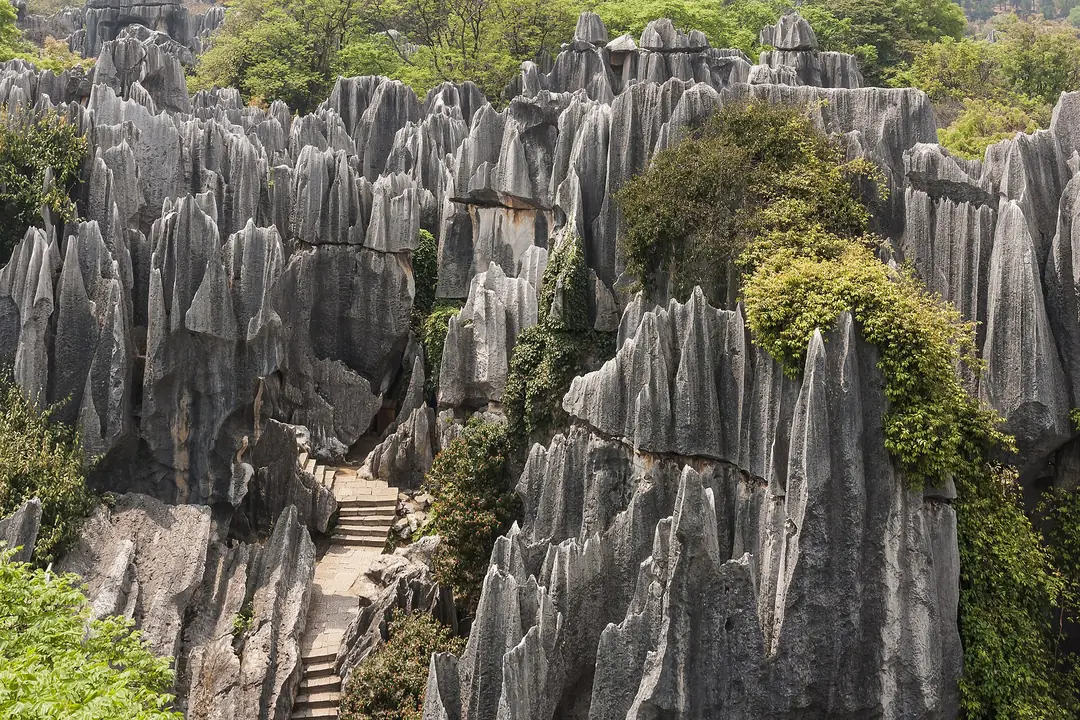
石林:两亿多年前的海底,如今是一片石头的森林。The Stone Forest: a seabed of long ago, now a forest of rock.El Bosque de Piedra: un antiguo fondo marino convertido en bosque de roca.图:Photo: Foto: CEphoto, Uwe Aranas · CC BY-SA 3.0
About an hour’s drive from downtown, a forest of limestone pinnacles rises taller than the trees — part of the South China Karst World Heritage Site since 2007. It is also home to the Sani people, a branch of the Yi, whose best-loved legend says the brave, beautiful Ashima was turned into one of these stones.
A una hora en coche del centro, un bosque de agujas de piedra caliza se alza más alto que los árboles; desde 2007 forma parte del Patrimonio Mundial «Karst del sur de China». Es también la tierra de los sani, una rama del pueblo yi, cuya leyenda más querida cuenta que la valiente y hermosa Ashima se convirtió en una de estas piedras.
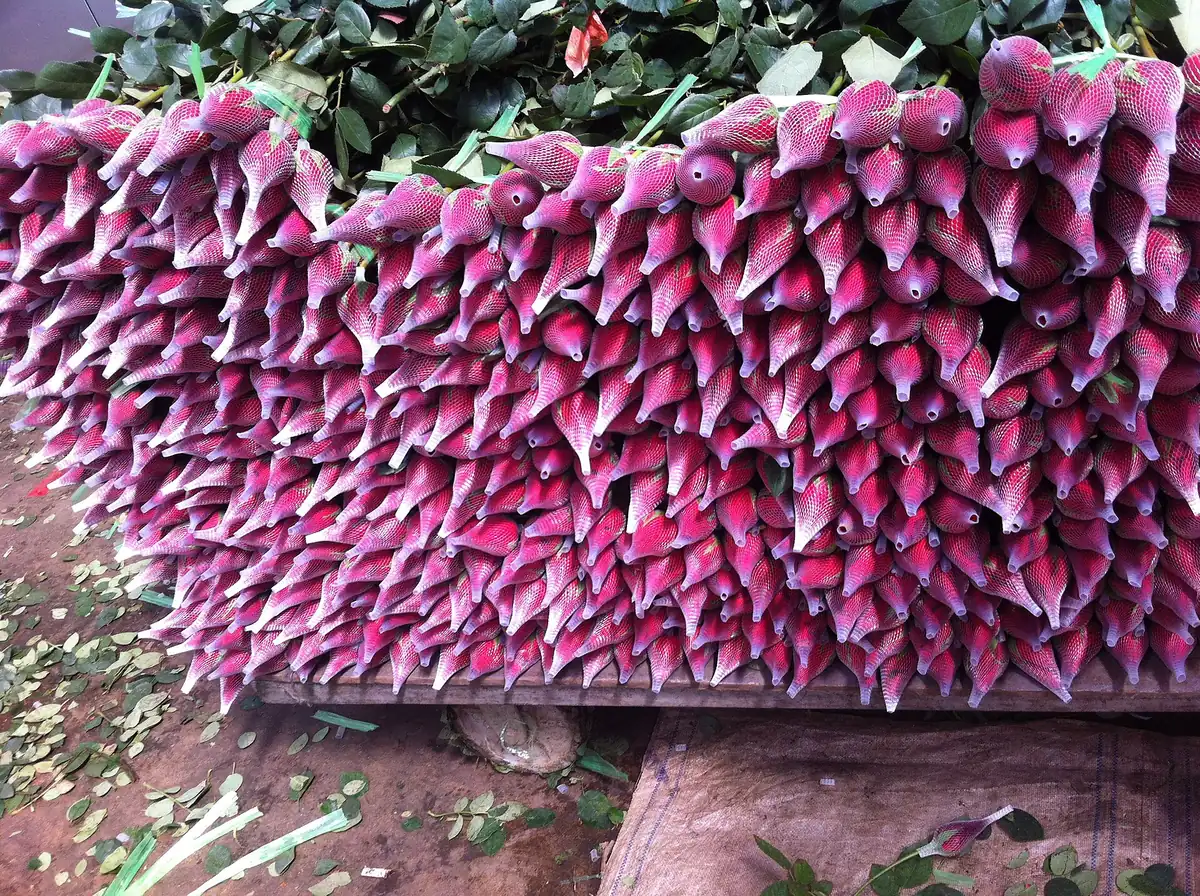
斗南花市:花是论扎、论箱卖的。Dounan flower market, where roses are sold by the armful.El mercado de flores de Dounan, donde las rosas se venden por brazadas.图:Photo: Foto: drnan tu from Shenzhen, China · CC BY-SA 2.0
斗南花市Dounan Flower MarketEl mercado de flores de Dounan
Dounan is one of the largest fresh-cut flower markets in Asia. Go in the evening, when it is busiest: roses, lilies and baby’s breath piled into hills, and a few dollars buys you an armful. It is the most literal explanation of the name “Spring City” you could ask for.
Dounan es uno de los mercados de flor cortada más grandes de Asia. Hay que ir al atardecer, cuando más movimiento hay: rosas, lirios y nube apilados en montañitas, y con unos pocos dólares uno se lleva una brazada. No hay explicación más literal del nombre «Ciudad de la Primavera».
伍 · 第五章Chapter fiveCapítulo cinco
再往远处:云南Farther afield: YunnanMás allá: Yunnan
「云南」,彩云之南。从昆明出发,雪山、古城、雨林、梯田都在几小时之内。Yunnan means “south of the clouds.” From Kunming, snow peaks, old towns, rainforest and rice terraces are all within a few hours.Yunnan quiere decir «al sur de las nubes». Desde Kunming, las montañas nevadas, los pueblos antiguos, la selva y las terrazas de arroz quedan a pocas horas.
一山分四季,十里不同天Four seasons on one mountainCuatro estaciones en una montaña
In Yunnan you can wake up beside a glacier and fall asleep at the edge of a rainforest. The province’s highest point is Kawagebo, crown of the Meili Snow Mountains, at about 6,740 m (22,100 ft); its lowest is at Hekou on the southern border, just 76.4 m (251 ft) above sea level. The air cools about 0.6 °C for every 100 m you climb, so a single mountain can grow bananas at its foot, tea on its shoulders, and snow on its summit.
En Yunnan uno puede despertar junto a un glaciar y dormirse al borde de la selva. El punto más alto de la provincia es el Kawagebo, cumbre de los montes nevados de Meili, a unos 6740 m; el más bajo está en Hekou, en la frontera sur, a solo 76,4 m sobre el nivel del mar. El aire se enfría unos 0,6 °C por cada 100 m de subida, así que en una misma montaña puede haber plátanos al pie, té en las laderas y nieve en la cumbre.
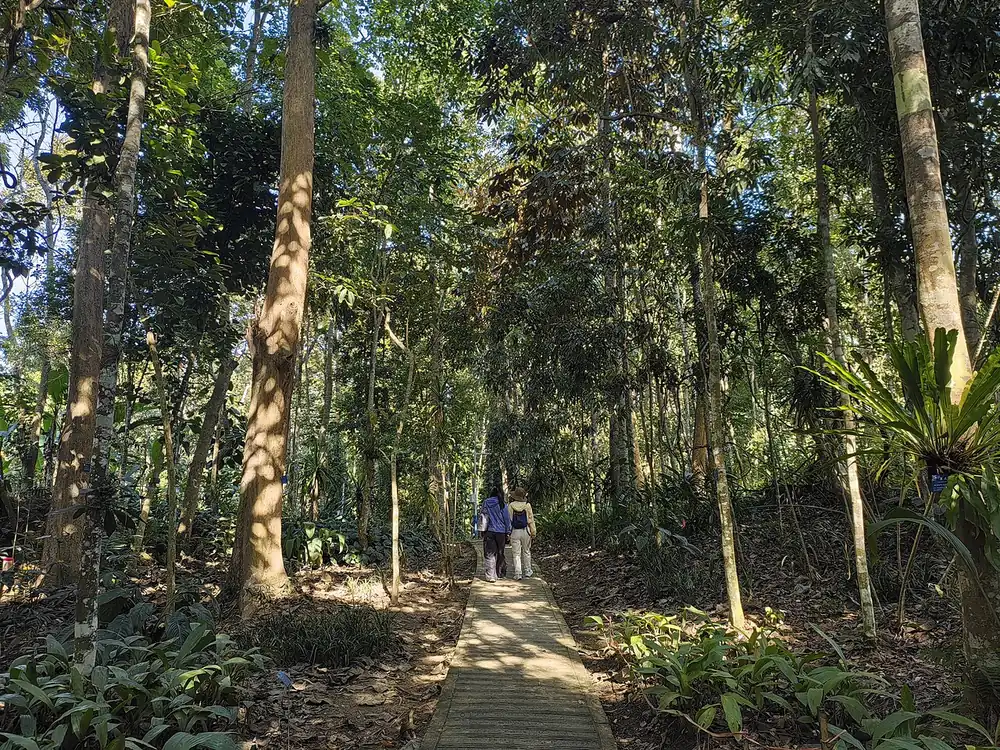
梅里雪山,主峰卡瓦格博约 6740 米,是云南的最高点。The Meili Snow Mountains; their summit, Kawagebo (about 6,740 m), is Yunnan’s highest point.Los montes nevados de Meili; su cumbre, el Kawagebo (unos 6740 m), es el punto más alto de Yunnan.图:Photo: Foto: Kevin Poh · CC BY 2.0西双版纳的热带雨林(中国科学院西双版纳热带植物园)。Tropical rainforest in Xishuangbanna, at the Chinese Academy of Sciences’ botanical garden.Selva tropical en Xishuangbanna, en el jardín botánico de la Academia China de Ciencias.图:Photo: Foto: Yumeto · CC BY-SA 4.0
昆明正好落在中间:海拔约一千九百米,又在低纬度,夏无酷暑、冬无严寒,才有了「春城」这个名字。
Kunming sits in the sweet spot — about 1,900 m (6,200 ft) up, at a subtropical latitude — which is exactly why it is never too hot or too cold, and why it is called the City of Eternal Spring.
Kunming queda justo en el punto medio: a unos 1900 m de altura y en una latitud subtropical. Por eso nunca hace demasiado calor ni demasiado frío, y por eso la llaman la Ciudad de la Eterna Primavera.
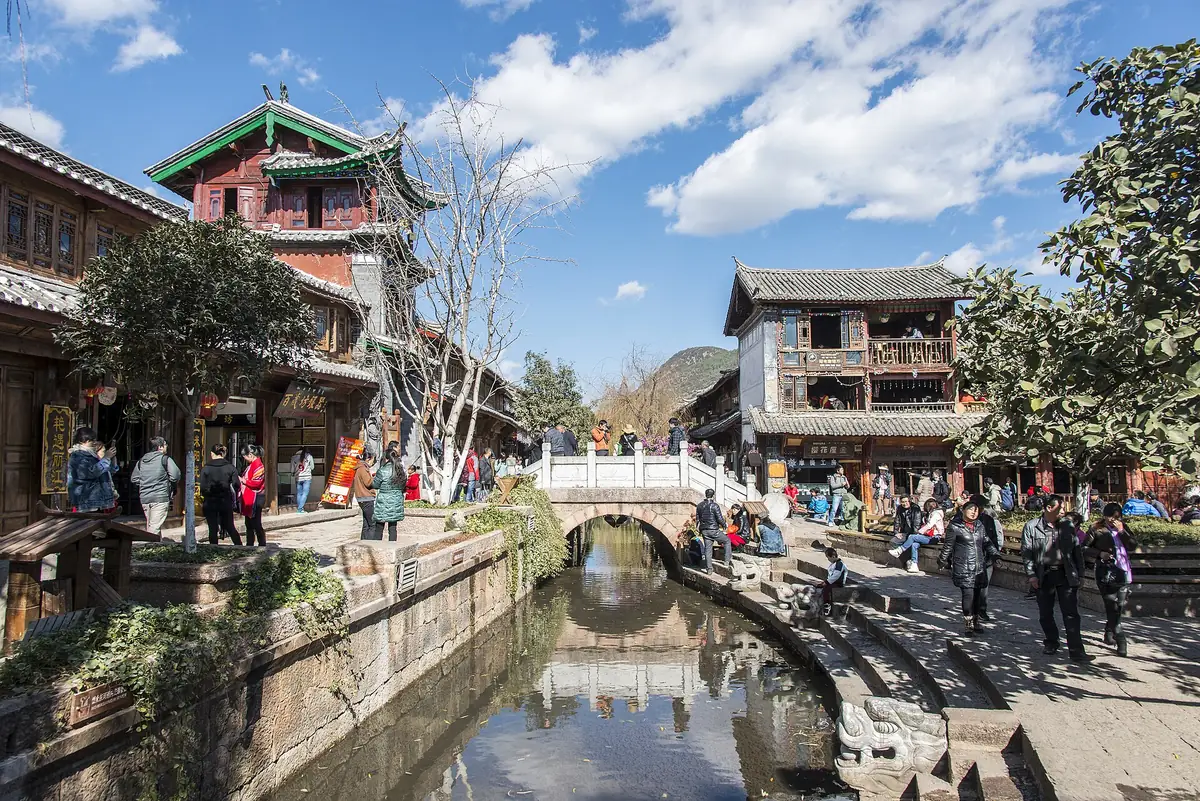
丽江古城,石板路、小桥和流水。Lijiang Old Town: flagstones, little bridges, running water.El casco antiguo de Lijiang: losas, puentecitos y agua que corre.图:Photo: Foto: chensiyuan · CC BY-SA 4.0
Home of the Naxi people and a World Heritage Site since 1997, Lijiang is a town built around water: snowmelt splits into little channels that run past nearly every doorstep, under the snowy peaks of Jade Dragon Snow Mountain.
Tierra del pueblo naxi y Patrimonio de la Humanidad desde 1997, Lijiang es un pueblo hecho alrededor del agua: el deshielo se divide en canalitos que pasan frente a casi todas las puertas, bajo las cumbres nevadas de la Montaña Nevada del Dragón de Jade.
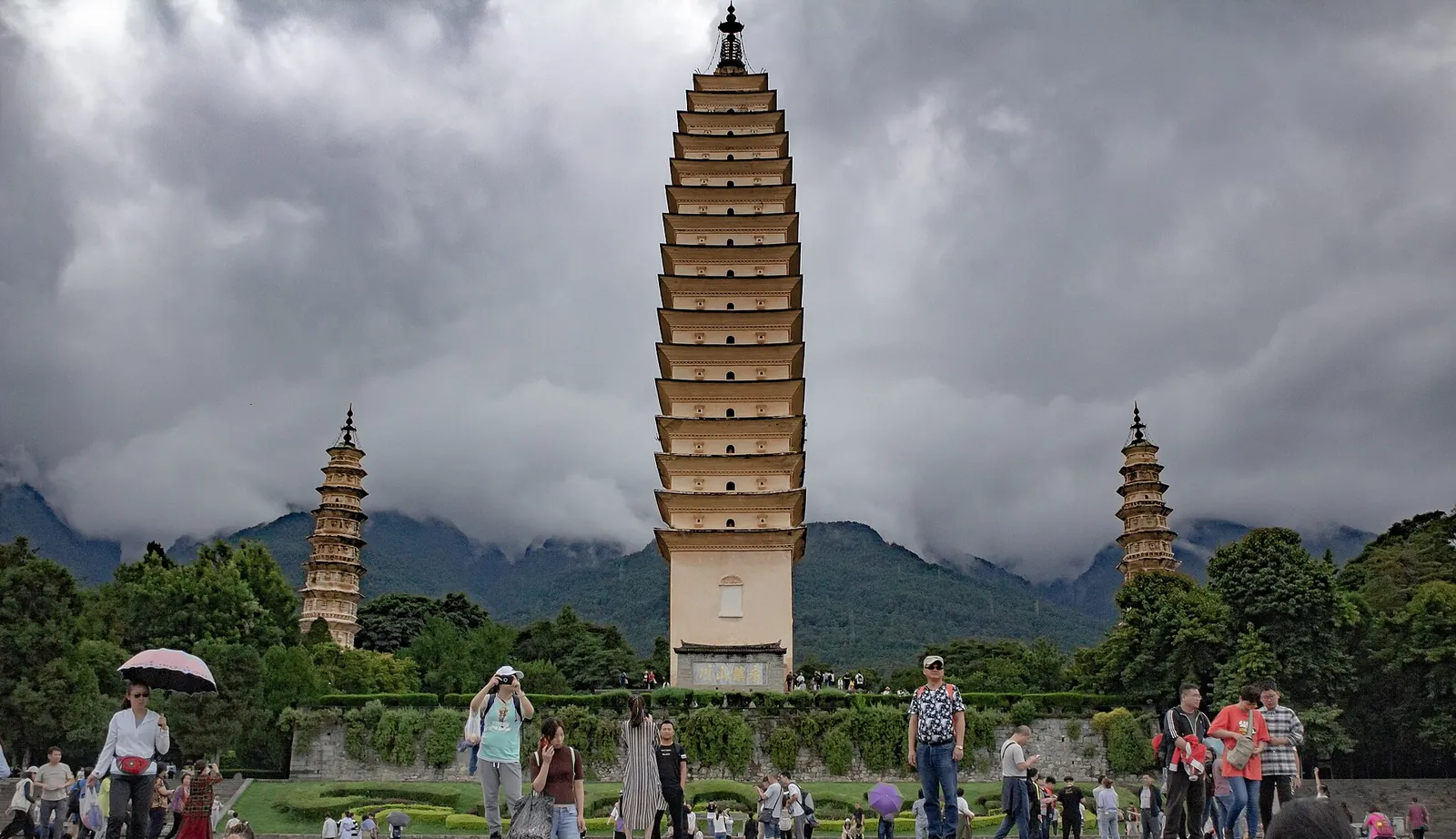
大理崇圣寺三塔,背靠苍山。The Three Pagodas of Dali, with the Cangshan range behind.Las Tres Pagodas de Dali, con la sierra de Cangshan detrás.图:Photo: Foto: Jason Zhang · CC BY-SA 3.0
大理:苍山洱海Dali, between mountain and lakeDali, entre la montaña y el lago
南诏和大理国的故都,白族的家园。西边是苍山,东边是洱海,崇圣寺三塔静静立在山湖之间。
Once capital of the Nanzhao and Dali kingdoms and heartland of the Bai people, Dali lies between the Cangshan range and the long blue mirror of Erhai Lake, its Three Pagodas standing quietly in between.
Antigua capital de los reinos de Nanzhao y Dali y corazón del pueblo bai, Dali se extiende entre la sierra de Cangshan y el largo espejo azul del lago Erhai, con sus Tres Pagodas en medio, en silencio.
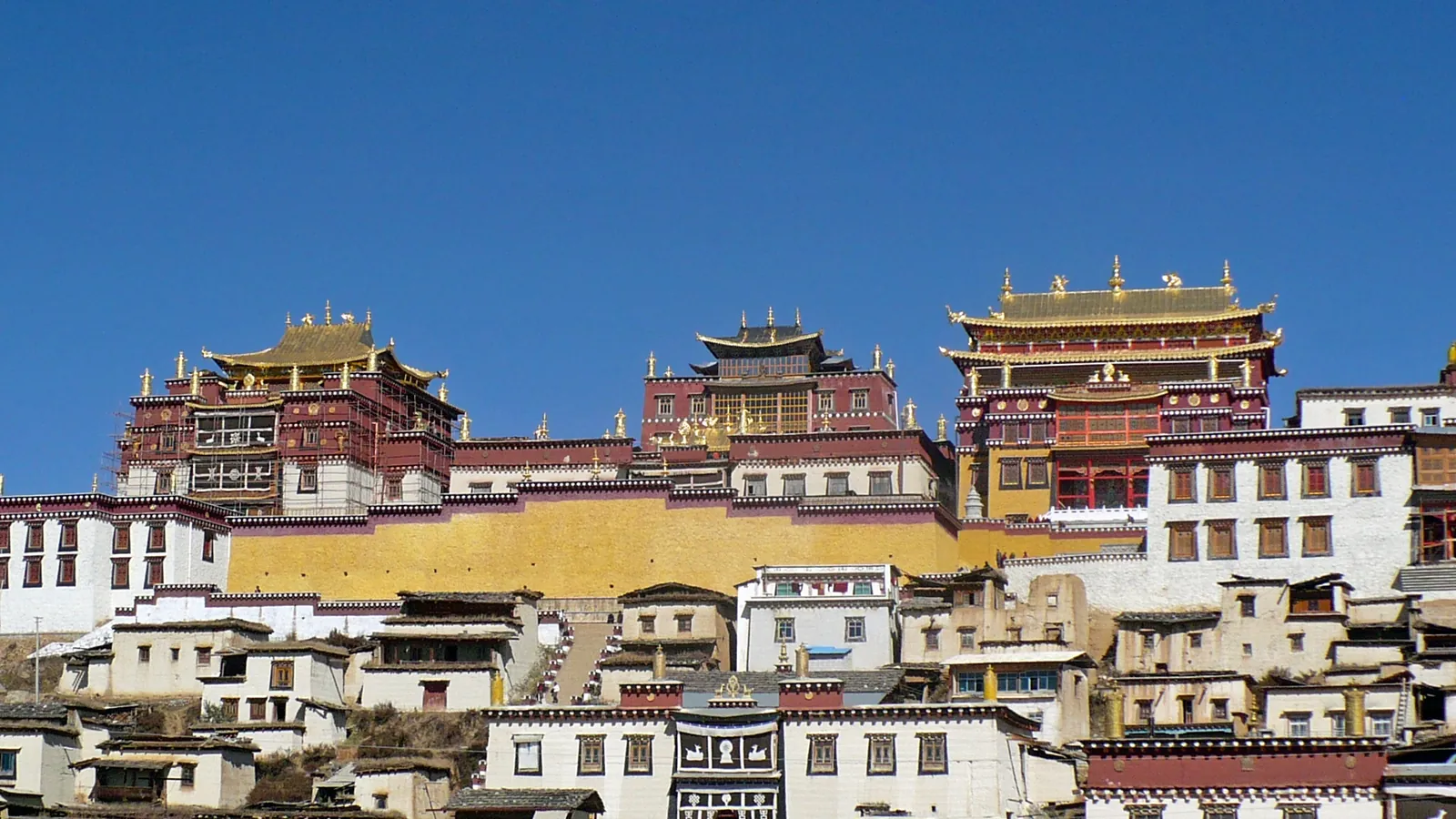
香格里拉的松赞林寺,被称作「小布达拉宫」。Ganden Sumtseling Monastery in Shangri-La, the “little Potala.”El monasterio de Ganden Sumtseling, en Shangri-La, el «pequeño Potala».图:Photo: Foto: Colin W · CC BY-SA 3.0
香格里拉Shangri-LaShangri-La
往西北走,就上了青藏高原的边缘:高山牧场、牦牛、经幡,还有金顶闪耀的松赞林寺。
Head northwest and you climb onto the edge of the Tibetan Plateau: alpine meadows, yaks, prayer flags and the golden roofs of Ganden Sumtseling Monastery.
Hacia el noroeste se sube al borde de la meseta tibetana: praderas de altura, yaks, banderas de oración y los techos dorados del monasterio de Ganden Sumtseling.
西双版纳的傣家建筑。Dai architecture in Xishuangbanna.Arquitectura dai en Xishuangbanna.图:Photo: Foto: Jacek Karczmarczyk · CC BY 3.0
Go south and you reach China’s tropics: rainforest and wild elephants, stilt houses and golden stupas — the homeland of the Dai people (see “The Dai” in chapter six).
Hacia el sur se llega al trópico chino: selva y elefantes salvajes, casas sobre pilotes y estupas doradas; es la tierra del pueblo dai (vea «Los dai», en el capítulo seis).
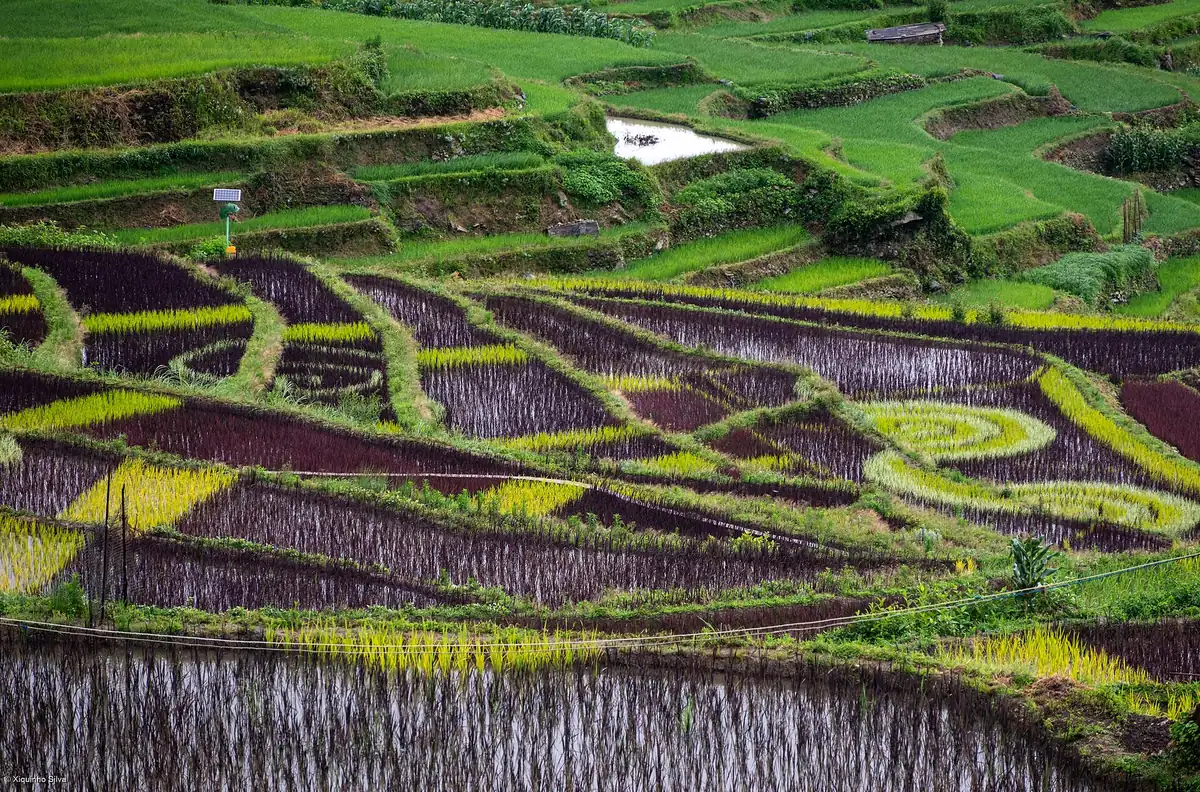
元阳的哈尼梯田,一层层铺满山坡。The Hani rice terraces of Yuanyang, climbing whole mountainsides.Las terrazas de arroz de los hani en Yuanyang, que cubren laderas enteras.图:Photo: Foto: xiquinhosilva · CC BY 2.0
元阳哈尼梯田The Hani Rice Terraces of YuanyangLas terrazas de arroz de Yuanyang
In the Ailao Mountains, the Hani people have spent more than 1,300 years sculpting whole mountainsides into terraces. In winter and spring, when they are flooded, sunrise and sunset turn them into thousands of mirrors. A World Heritage Site since 2013 — and where a bowl of mixian really begins: with a grain of Yunnan rice.
En los montes Ailao, el pueblo hani lleva más de 1300 años convirtiendo laderas enteras en terrazas. En invierno y primavera, cuando están inundadas, el amanecer y el atardecer las vuelven miles de espejos. Son Patrimonio de la Humanidad desde 2013, y ahí empieza de verdad un tazón de mixian: con un grano de arroz de Yunnan.
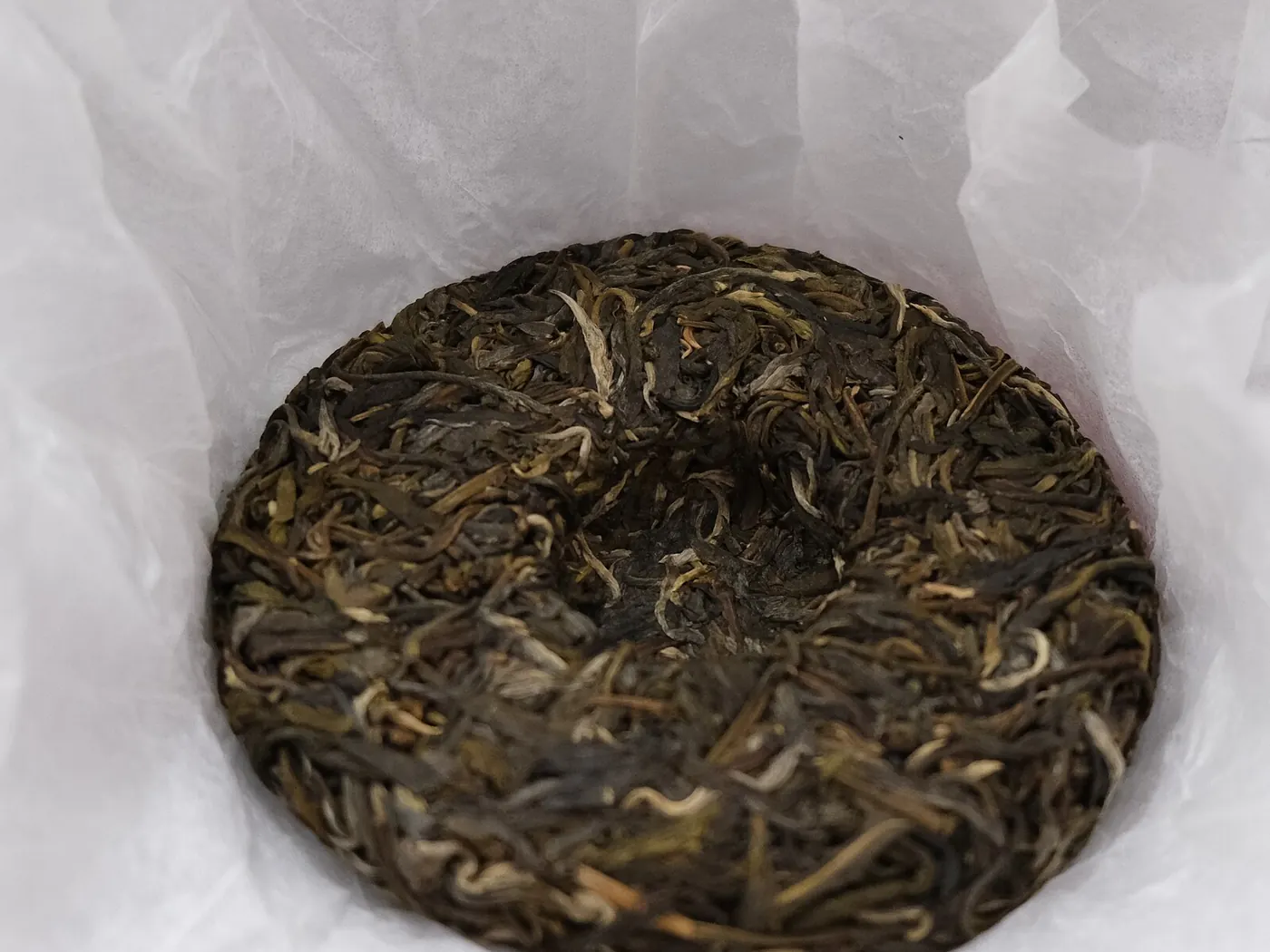
一饼生普洱,压得紧实。A pressed cake of raw Pu’er tea.Un pastel prensado de té pu’er crudo.图:Photo: Foto: Ash Crow · CC BY-SA 4.0
Pu’er tea takes its name from the town of Pu’er. Pressed into cakes, it was once carried by mule caravans along the Tea Horse Road over the mountains; the good cakes grow richer with every year in storage. In a cup of Pu’er, you are tasting time.
El té pu’er lleva el nombre de la ciudad de Pu’er. Prensado en pasteles, lo cargaban las caravanas de mulas por el Camino del Té y los Caballos, montaña tras montaña; los buenos pasteles mejoran con cada año de guarda. En una taza de pu’er se saborea el tiempo.
陆 · 第六章Chapter sixCapítulo seis
风土人情Peoples, festivals & folklorePueblos, fiestas y leyendas
Yunnan is China’s most diverse province. Alongside the Han majority, twenty-five ethnic minorities have long called it home. The torches of the Yi, the “three-course tea” of the Bai, the ancient music of the Naxi, the peacock dance of the Dai: crossing Yunnan’s mountains is like opening one book after another, each in a different language. To meet all twenty-six peoples one by one, see chapter eight.
Yunnan es la provincia más diversa de China. Además de la mayoría han, veinticinco minorías étnicas viven aquí desde hace generaciones. Las antorchas de los yi, el «té de tres tiempos» de los bai, la música antigua de los naxi, la danza del pavo real de los dai: cruzar las montañas de Yunnan es como abrir un libro tras otro, cada uno en un idioma distinto. Para conocer a los veintiséis pueblos uno por uno, vea el capítulo ocho.
傣族:孔雀之乡The Dai: people of the peacockLos dai: el pueblo del pavo real
Follow the Lancang — the upper Mekong — south to Xishuangbanna and Dehong, and you enter the homeland of the Dai, who grow rice in warm river valleys beside slow rivers. Most practice Theravada Buddhism, and in every village the golden-roofed temple is the heart of community life.
Siguiendo el Lancang —el curso alto del Mekong— hacia el sur, hasta Xishuangbanna y Dehong, se entra en la tierra de los dai, que cultivan arroz en valles cálidos junto a ríos tranquilos. La mayoría practica el budismo theravada, y en cada aldea el templo de techo dorado es el corazón de la vida comunitaria.
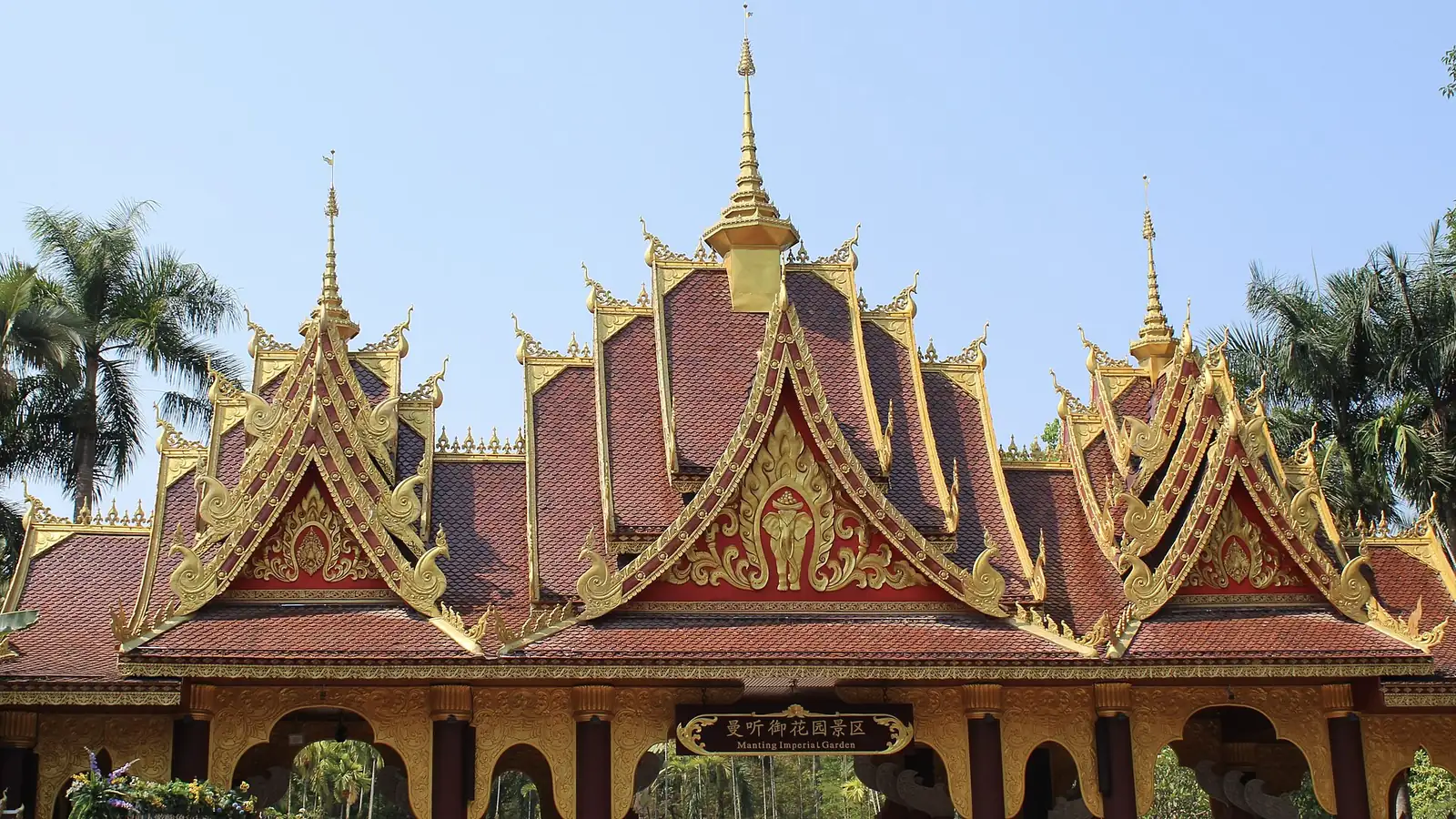
景洪曼听公园,旧时是傣王的御花园。Manting Park in Jinghong, once a royal garden of the Dai kings.El parque Manting, en Jinghong, antiguo jardín real de los reyes dai.图:Photo: Foto: AgathaMayJr · CC BY 4.0
泼水节The Water-Splashing FestivalLa Fiesta del Agua傣历新年,一般在公历 4 月中旬。先浴佛,再互相泼水,水泼得越多,祝福越深。2006 年列入首批国家级非物质文化遗产名录。The Dai New Year, usually in mid-April. It begins gently, with families bathing statues of the Buddha, then turns into a joyful soaking: the wetter you get, the more blessings you receive. Listed as national intangible cultural heritage in 2006.El Año Nuevo dai, por lo general a mediados de abril. Empieza con calma, cuando las familias bañan las imágenes de Buda, y termina en una mojada alegre: cuanto más empapado, más bendiciones. Patrimonio cultural inmaterial nacional desde 2006.
竹楼Bamboo stilt housesCasas de bambú sobre pilotes上层住人,下层架空,通风防潮,正适合湿热的河谷。Living quarters raised high on posts, open beneath so breezes flow through and the damp stays out — perfect for a humid valley.La vivienda va en alto, sobre postes, y abajo queda abierta para que corra el aire y no entre la humedad: perfecta para un valle caluroso y húmedo.
孔雀舞The peacock danceLa danza del pavo real舞者模仿孔雀饮水、展翅、开屏,手形和步子都轻盈柔美。Dancers trace a peacock drinking at a stream, unfolding its wings, fanning its tail — every finger and step light as a feather.Los bailarines imitan al pavo real que bebe en el arroyo, despliega las alas y abre la cola; cada dedo y cada paso, ligeros como una pluma.
傣味Dai cookingLa cocina dai酸、辣、鲜、香,大量用香茅草、青柠檬、薄荷、芫荽。最有名的是香茅草烤鱼,还有紫糯米装进菠萝里蒸的菠萝饭。很多昆明人吃过一次傣味,就一直惦记着那股酸辣清香。Bright, sour, spicy and herb-forward: lemongrass, lime, mint, cilantro. The signature is lemongrass-grilled fish; then there is purple sticky rice steamed inside a hollowed-out pineapple. For plenty of people in Kunming, one taste of Dai food is the start of a lifelong craving.Ácida, picante, fresca y llena de hierbas: zacate limón, limón, menta, cilantro. Lo más famoso es el pescado asado envuelto en zacate limón, y también el arroz glutinoso morado cocido al vapor dentro de una piña. A mucha gente de Kunming le basta probarla una vez para extrañarla siempre.
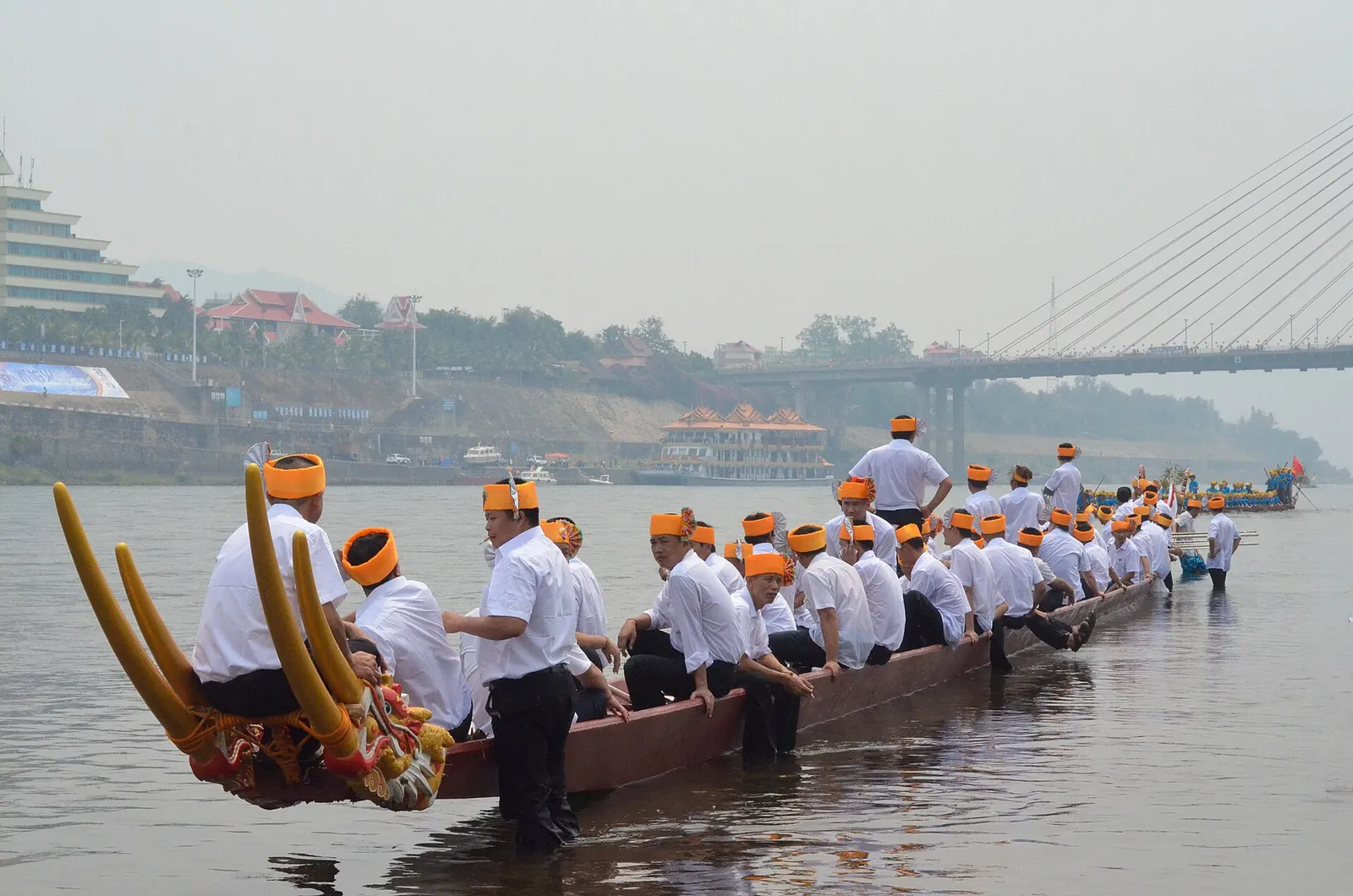
泼水节期间的龙舟赛(2013 年 4 月)。Dragon-boat racing during the Water-Splashing Festival, April 2013.Carrera de botes de dragón durante la Fiesta del Agua, abril de 2013.图:Photo: Foto: Peter Olshevsky · CC BY-SA 4.0
节庆FestivalsFiestas
火把节The Torch FestivalLa Fiesta de las Antorchas彝族、白族等民族最盛大的节日,一般在农历六月二十四前后。入夜,村寨里火把连成火龙,人们围着篝火唱歌跳舞,祈求丰收。The great midsummer festival of the Yi, Bai and other peoples, usually around the 24th day of the sixth lunar month. After dark, villages blaze with torches; people sing and dance around bonfires for a good harvest.La gran fiesta de pleno verano de los yi, los bai y otros pueblos, por lo general hacia el día 24 del sexto mes lunar. Al caer la noche las aldeas arden de antorchas y la gente canta y baila alrededor de las hogueras para pedir una buena cosecha.
三月街Third Month FairLa Feria del Tercer Mes大理白族的传统盛会,农历三月十五前后在苍山脚下举行,赛马、对歌、做买卖,延续了许多世纪。Held at the foot of the Cangshan mountains around the 15th of the third lunar month, the Bai people’s great fair of horse races, song contests and trading has drawn crowds for centuries.Se celebra al pie de la sierra de Cangshan hacia el día 15 del tercer mes lunar: la gran feria del pueblo bai, con carreras de caballos, duelos de canto y comercio, reúne multitudes desde hace siglos.
过桥米线的传说The legend of crossing-the-bridge noodlesLa leyenda de los fideos que cruzan el puente
A folk tale — beloved, but not documented history. Long ago, in the Qing dynasty, a young scholar shut himself away on a little island in Mengzi’s South Lake to study for the imperial exams. Every day his wife cooked his meals and carried them across a long bridge — and every day they arrived cold. One day she stewed a fat chicken and noticed that the thick layer of golden fat sealed in the heat like a lid. She carried the soup across, slipped in the noodles, meat and greens at his table, and the bowl arrived piping hot. He passed his exams; people said her noodles deserved some of the credit; and the dish has been called “crossing the bridge” ever since.
Un cuento popular, muy querido, pero no historia documentada. Dicen que hace mucho tiempo, en tiempos de la dinastía Qing, un joven letrado se encerró en una islita del lago del Sur, en Mengzi, para preparar los exámenes imperiales. Todos los días su esposa le cocinaba y le llevaba la comida cruzando un largo puente, y todos los días la comida llegaba fría. Un día preparó un caldo con una gallina gorda y se dio cuenta de que la gruesa capa de grasa dorada guardaba el calor como una tapa. Cruzó el puente con el caldo, echó los fideos, la carne y las verduras ya en la mesa de su marido, y el tazón llegó hirviendo. Él aprobó los exámenes; la gente dijo que parte del mérito era de aquellos fideos, y desde entonces el plato se llama «fideos que cruzan el puente».
云南十八怪(挑几怪)A few of Yunnan’s “Eighteen Oddities”Algunas de las «Dieciocho rarezas» de Yunnan
云南人爱用顺口溜调侃自己家乡的「怪」事,叫「云南十八怪」。版本很多,这里挑几条:
Yunnanese love a good-humored rhyme about the quirks of home, known as the “Eighteen Oddities of Yunnan.” There are many versions; here are a few favorites:
A la gente de Yunnan le encanta burlarse con cariño de las rarezas de su tierra en unos versos conocidos como las «Dieciocho rarezas de Yunnan». Hay muchas versiones; aquí van algunas de las favoritas:
鸡蛋用草串着卖Eggs are sold strung on strawLos huevos se venden ensartados en paja山里人用稻草把鸡蛋一个个编起来,提着走山路不怕碰碎。Villagers braid eggs into straw ropes so they survive the mountain paths to market.En el campo trenzan los huevos en cuerdas de paja para que lleguen enteros al mercado por los caminos de montaña.
火车没有汽车快The train is slower than the carEl tren va más lento que el coche说的是老米轨铁路:窄窄的铁轨在山谷里绕来绕去,跑得比公路上的汽车还慢。A nod to the old narrow-gauge railway, winding so slowly through the gorges that cars on the road could beat it.Por el viejo tren de vía estrecha, que serpenteaba tan despacio por las gargantas que los coches de la carretera le ganaban.
四季衣服同穿戴All four seasons’ clothes at onceLa ropa de las cuatro estaciones, a la vez早晚凉、中午晒,同一条街上有人穿棉袄,有人穿短袖。Cool mornings, hot noons: on the same street you’ll see a puffer jacket and a T-shirt.Mañanas frescas y mediodías de sol: en la misma calle se ven chamarras acolchadas y camisetas.
米线叫过桥The noodles are called “crossing the bridge”A los fideos les dicen «que cruzan el puente»就是上面那个故事。See the story above.Es la historia de arriba.
竹筒能当烟袋用A bamboo tube for a pipeUn tubo de bambú como pipa粗竹筒做的水烟筒,是滇中男人茶馆里、田埂上的老伙计。A thick bamboo water pipe is the old companion of many a Yunnan farmer and teahouse regular.Una gruesa pipa de agua de bambú es la vieja compañera de muchos campesinos y parroquianos de las casas de té de Yunnan.
柒 · 第七章Chapter sevenCapítulo siete
一碗米线里的云南Yunnan in a bowl of mixianYunnan en un tazón de mixian
同一把米线,翻过一座山就换一种吃法。点一点碗边的名字。The same handful of rice noodles, eaten a different way on every side of every mountain. Tap a name around the rim.El mismo puñado de fideos de arroz, comido de otra manera a cada lado de cada montaña. Toque un nombre alrededor del borde.
过桥米线Crossing-the-bridgeCruzando el puente
蒙自 · 汉族Mengzi · HanMengzi · han
滚烫的鸡汤封着一层鸡油端上桌,生肉片、菜蔬、米线依次下进去,桌上现烫现吃。它来自滇南的蒙自,2014 年制作技艺列入国家级非遗。A bowl of scalding chicken broth arrives sealed under a layer of fat; raw sliced meat, greens and noodles go in one after another and cook at the table. It comes from Mengzi in southern Yunnan; the technique was listed as national intangible heritage in 2014.Llega un tazón de caldo de gallina hirviendo sellado bajo una capa de grasa; la carne cruda en láminas, las verduras y los fideos entran uno tras otro y se cuecen en la mesa. Viene de Mengzi, en el sur de Yunnan; la técnica es patrimonio inmaterial nacional desde 2014.
一排小铜锅架在火上,一锅只煮一碗:肉末、酸腌菜、韭菜、豌豆尖咕嘟一小会儿,淋一勺甜酱油。它从玉溪传到昆明,如今是昆明人最当作「自己的」那一碗。A row of small copper pots over the flame, one bowl per pot: minced pork, pickled greens, chives and pea shoots bubble for a minute, then a spoonful of sweet soy. It came to Kunming from Yuxi and is now the bowl the city calls its own.Una fila de ollitas de cobre al fuego, un tazón por olla: carne molida, verdura encurtida, cebollín y brotes de chícharo hierven un momento y luego una cucharada de soya dulce. Llegó a Kunming desde Yuxi y hoy es el tazón que la ciudad siente más suyo.
清真牛肉米线Halal beefRes halal
昆明 · 回族Kunming · HuiKunming · hui
回族人开的清真馆子里,牛骨汤熬得清亮,上面铺几片卤牛肉或一撮牛干巴,撒上葱花、芫荽和辣椒。昆明许多人早上第一碗,就是它。In a Hui-run halal shop the beef-bone broth is simmered clear, topped with slices of braised beef or a pinch of dried beef, scallions, cilantro and chili. For many in Kunming this is the first bowl of the morning.En una fonda halal de los hui, el caldo de hueso de res se cuece hasta quedar claro, y encima van láminas de res estofada o un poco de cecina, cebolla verde, cilantro y chile. Para mucha gente de Kunming es el primer tazón de la mañana.
不是汤米线,是蘸着吃:细米线配一碗酸辣的「撒撇」汁——用柠檬,或者牛苦肠汁,加上大量香草和辣椒。热天里一口下去,又酸又凉又辣。Not a soup but a dip: thin rice noodles with a bowl of sharp sapie sauce — made with lime, or with the bitter juice of beef tripe, plus plenty of herbs and chili. On a hot day it is sour, cool and fiery all at once.No es sopa, se moja: fideos de arroz finos con un tazón de salsa sapie intensa, hecha con lima o con el jugo amargo de la tripa de res, más muchas hierbas y chile. En un día de calor es ácido, fresco y picante a la vez.
一小团米线放在手心,舀上肉末、豌豆粉、蒜泥和酸水调的拌料,手指一裹送进嘴里——不用碗也不用筷子。这是德宏阿昌人的吃法,各家的配料都有自己的讲究。A small nest of noodles laid in the palm, topped with minced pork, pea jelly, garlic and a sour dressing, then wrapped with the fingers and eaten in one bite — no bowl, no chopsticks. This is how the Achang of Dehong eat it, and every family has its own toppings.Un pequeño nido de fideos en la palma, con cerdo picado, gelatina de guisante, ajo y un aliño ácido, que se envuelve con los dedos y se come de un bocado: sin tazón y sin palillos. Así lo comen los achang de Dehong, y cada familia tiene sus propios ingredientes.
大理人的早点:豌豆磨成浆熬成稠稠的稀豆粉,浇在米线上,再撒花椒油、辣椒面、葱花和芫荽。稠、糯、香,一碗下去身上就暖了。A Dali breakfast: yellow peas ground and cooked into a thick porridge, poured over noodles and finished with Sichuan-pepper oil, chili flakes, scallions and cilantro. Thick, silky and fragrant — one bowl and you are warm.Un desayuno de Dali: guisantes molidos y cocidos hasta formar una crema espesa, vertida sobre los fideos y rematada con aceite de pimienta de Sichuan, chile molido, cebolla verde y cilantro. Espeso, sedoso y aromático: un tazón y ya entra el calor.
草芽是建水水边才有的一种嫩芽,像象牙一样白,脆生生的。建水人把它切段和米线一起烫,是别处吃不到的一碗。Caoya is a tender white reed shoot that grows only in the waters around Jianshui, crisp as a fresh bamboo shoot. Sliced and dropped into the bowl with the noodles, it is a mixian you cannot find anywhere else.El caoya es un brote de junco tierno y blanco que solo crece en las aguas de Jianshui, crujiente como un brote de bambú fresco. Cortado y echado al tazón con los fideos, es un mixian que no se encuentra en ningún otro lugar.
滇东南的文山一带,汤是酸的——用番茄、酸菜或自家发酵的酸汤熬出来,开胃解暑。壮族、苗族的村子里,这一碗酸酸辣辣的米线最常见。In Wenshan, in Yunnan's southeast, the broth is sour — cooked with tomato, pickled greens or a home-fermented sour stock, bracing in hot weather. In Zhuang and Miao villages this tart, spicy bowl is the everyday one.En Wenshan, al sureste de Yunnan, el caldo es ácido: se hace con tomate, verdura encurtida o un fondo ácido fermentado en casa, muy refrescante con el calor. En las aldeas zhuang y miao, este tazón ácido y picante es el de todos los días.
点碗边的名字,看那一碗是怎么吃的。Tap a name on the rim to see how that bowl is eaten.Toque un nombre del borde para ver cómo se come ese tazón.
The Han turned it into crossing-the-bridge noodles; the Hui simmer it in clear beef-bone broth; the Dai dip it in a sharp sapie sauce; the Achang simply fold it up in the palm of the hand. Kunming sits in the middle of this big table — every region’s way of eating arrives here, and yet the bowl Kunming claims as its own is still the small copper pot on the corner. The braised-pork, three-treasure and cold mixian on our menu are the Kunming corner of that table.
Los han lo convirtieron en los fideos que cruzan el puente; los hui lo sirven en un caldo claro de hueso de res; los dai lo mojan en una salsa sapie intensa; los achang, sencillamente, lo envuelven en la palma de la mano. Kunming está en el centro de esa gran mesa: a ella llegan las maneras de comer de toda la provincia, y aun así el tazón que Kunming siente más suyo sigue siendo la ollita de cobre de la esquina. El mixian con cerdo estofado, el de tres delicias y el mixian frío de nuestra carta son el rincón de Kunming en esa mesa.
捌 · 第八章Chapter eightCapítulo ocho
云南:二十六个民族Yunnan: twenty-six peoplesYunnan: veintiséis pueblos
这张大饭桌上的二十六把椅子。Twenty-six chairs at one big table.Veintiséis sillas alrededor de una misma mesa.
Leave Kunming and cross any mountain, and the accents, the clothes and the food on the table all change. Yunnan is home to twenty-six peoples who have lived here for generations — the Han, plus twenty-five ethnic minorities, more than any other province in China; fifteen of them live nowhere else in the country. Some build bamboo houses on stilts by the river; some have carved rice terraces into mountainsides two thousand meters high; some celebrate the new year by throwing water at each other, others by carrying torches through the night. Sit down for a bowl of mixian on a Kunming street and the person on the next stool might be Bai, Yi or Hui.
Basta salir de Kunming y cruzar una montaña para que cambien el acento, la ropa y lo que se sirve en la mesa. En Yunnan viven veintiséis pueblos que llevan generaciones en esta tierra: los han y veinticinco minorías étnicas, más que en cualquier otra provincia de China; quince de ellas no viven en ningún otro lugar del país. Unos construyen casas de bambú sobre pilotes junto al río; otros han tallado terrazas de arroz en laderas a dos mil metros de altura; unos reciben el año nuevo echándose agua, otros recorriendo la noche con antorchas. Siéntese a comer un tazón de mixian en una calle de Kunming y quizá su vecino de banco sea bai, yi o hui.
他们住在哪里Where they liveDónde viven
这是一张示意图,不是精确的边界:圆点是云南的十六个州市,点一下看那里住着谁。
A schematic map, not exact borders: the dots are Yunnan’s sixteen prefectures and cities. Tap one to see who lives there.
Es un mapa esquemático, no de fronteras exactas: los puntos son las dieciséis prefecturas y ciudades de Yunnan. Toque uno para ver quién vive allí.
昆明KunmingKunming
省会,春城。清真牛肉米线、小锅米线都在街角。The capital, the Spring City. Halal beef mixian and small-pot mixian on every corner.La capital, la Ciudad de la Primavera. Mixian halal de res y mixian de olla pequeña en cada esquina.
小锅米线的老家;通海兴蒙乡住着云南的蒙古族。Birthplace of small-pot mixian; Xingmeng in Tonghai is home to Yunnan's Mongols.Cuna del mixian de olla pequeña; en Xingmeng, Tonghai, viven los mongoles de Yunnan.
彝族自治州,火把节的大舞台。The Yi autonomous prefecture — a great stage for the Torch Festival.Prefectura autónoma yi, gran escenario de la Fiesta de las Antorchas.
蒙自的过桥米线、建水的草芽米线、元阳的哈尼梯田。Crossing-the-bridge noodles in Mengzi, reed-shoot mixian in Jianshui, the Hani terraces of Yuanyang.Los fideos que cruzan el puente de Mengzi, el mixian con brotes de junco de Jianshui, las terrazas hani de Yuanyang.
苍山洱海之间,白族三道茶、三月街。Between mountain and lake: Bai three-course tea and the Third Month Fair.Entre la montaña y el lago: el té de tres tazas de los bai y la Feria del Tercer Mes.
腾冲饵丝的老家,老滇西的马帮驿站。Home of Tengchong ersi and an old caravan stop in western Yunnan.Cuna del ersi de Tengchong y antigua parada de caravanas en el oeste de Yunnan.
目瑙纵歌、阿昌过手米线、户撒刀。Munao Zongge, Achang hand-held mixian and the knives of Husa.El Munao Zongge, el mixian en la mano de los achang y los cuchillos de Husa.
示意图 · 自绘,位置按各州市首府经纬度排布。Schematic, drawn by us; dots placed by the coordinates of each prefecture seat.Esquemático, dibujado por nosotros; los puntos siguen las coordenadas de cada capital de prefectura.
二十六张卡片Twenty-six cardsVeintiséis tarjetas
带 🍜 的四张,和米线直接有关。视频都是独立博主或外国公共电视台拍的,点了才会加载。
The four cards marked 🍜 have a mixian story of their own. The videos are by independent creators or foreign public broadcasters, and load only when you tap them.
Las cuatro tarjetas con 🍜 tienen su propia historia de mixian. Los videos son de creadores independientes o de televisiones públicas extranjeras, y solo se cargan al tocarlos.
汉族HanHan🍜
云南的汉人很多是明代随军屯田来的,六百多年前从南京、江南一带迁来,至今不少人家还说「祖籍南京应天府」。也正是他们把一碗米线吃出了花样——蒙自过桥米线的故事,讲的就是一位妻子为了让在湖心岛读书的丈夫吃上一口热饭,用一层鸡油封住滚汤。Many of Yunnan's Han families arrived more than six hundred years ago, when Ming-dynasty soldiers were sent to settle and farm the frontier; some still say their ancestors came "from Nanjing." They are the ones who turned rice noodles into an art — the legend of crossing-the-bridge noodles from Mengzi tells of a wife who sealed a pot of boiling broth under a layer of chicken fat so her husband, studying on an island, could still eat it hot.Muchas familias han de Yunnan llegaron hace más de seiscientos años, cuando la dinastía Ming envió soldados a colonizar y cultivar la frontera; todavía hay quien dice que sus antepasados vinieron «de Nankín». Fueron ellos quienes convirtieron los fideos de arroz en un arte: la leyenda del mixian «que cruza el puente», de Mengzi, cuenta que una esposa selló una olla de caldo hirviendo bajo una capa de grasa de pollo para que su marido, que estudiaba en una isla, pudiera comerlo todavía caliente.
语言与文字Language & writingLengua y escritura汉语,写汉字。Chinese, written in Chinese characters.Chino, escrito con caracteres chinos.
彝族YiYi
云南人口最多的少数民族,五百多万人。每年农历六月二十四是火把节,整座村子点起火把,围着篝火跳到深夜。昆明东边的石林,是彝族支系撒尼人的家乡,阿诗玛的故事就在那里流传。The largest minority in Yunnan, more than five million people. On the 24th day of the sixth lunar month comes the Torch Festival: whole villages light torches and dance around bonfires late into the night. The Stone Forest east of Kunming is home to the Sani, a branch of the Yi, and the place where the legend of Ashima is told.Es la minoría más numerosa de Yunnan, con más de cinco millones de personas. El día 24 del sexto mes lunar llega la Fiesta de las Antorchas: pueblos enteros encienden antorchas y bailan alrededor de las hogueras hasta muy tarde. El Bosque de Piedra, al este de Kunming, es la tierra de los sani, una rama de los yi, y el lugar donde se cuenta la leyenda de Ashima.
语言与文字Language & writingLengua y escritura彝语,有自己的古老文字——彝文。现存最早有确切年代的彝文,是 1485 年一口铜钟上的铭文。四川凉山 1974 年整理出规范彝文,云南另有自己的一套规范方案。Yi, with an old script of its own. The earliest dated Yi writing is an inscription on a bronze bell from 1485. Sichuan standardized the script in 1974; Yunnan has its own standard.Yi, con una escritura antigua propia. El texto yi fechado más antiguo es una inscripción en una campana de bronce de 1485. Sichuan normalizó la escritura en 1974; Yunnan tiene su propia norma.
哈尼族HaniHani
一千多年来,哈尼人在哀牢山上一锹一锹开出梯田,山顶是森林,半山是村寨,下面是层层水田,靠一条条水沟分水。2013 年红河哈尼梯田列入世界遗产。初春过节时,村里人把各家的饭桌在村道上连成一条长龙,这就是「长街宴」。For more than a thousand years the Hani have carved rice terraces into the Ailao Mountains by hand: forest on the summit, villages halfway down, flooded paddies stepping toward the valley, with water shared out through a web of channels. The Honghe Hani Rice Terraces became a UNESCO World Heritage site in 2013. At the early-spring festival, families carry their tables into the village street and join them into one long line — the "long-street banquet."Desde hace más de mil años, los hani han tallado a mano terrazas de arroz en los montes Ailao: bosque en la cima, aldeas a media ladera y arrozales inundados que bajan escalonados hacia el valle, con el agua repartida por una red de canales. Las terrazas de Honghe son Patrimonio de la Humanidad de la UNESCO desde 2013. En la fiesta de principios de primavera, cada familia saca su mesa a la calle y todas se unen en una sola fila: el «banquete de la calle larga».
语言与文字Language & writingLengua y escritura哈尼语。传说哈尼人古时有文字,在迁徙路上丢了;今天用的是 1950 年代创制的拉丁字母文字。Hani. Legend says the Hani once had a script and lost it on their long migration; today Hani is written in a Latin alphabet created in the 1950s.Hani. La leyenda cuenta que los hani tuvieron una escritura y la perdieron en su larga migración; hoy se escribe con un alfabeto latino creado en los años cincuenta.
白族BaiBai
住在大理苍山洱海之间,崇尚白色,房子是白墙青瓦。待客要上「三道茶」:一苦、二甜、三回味,像一段人生。每年农历三月十五的三月街,是一千多年的老集市;周城的扎染、洱源的乳扇,都是白族人的手艺。The Bai live between the Cangshan Mountains and Erhai Lake in Dali, and they love the color white — their houses are whitewashed walls under grey tiles. Guests are served "three-course tea": first bitter, then sweet, then lingering, like a life. The Third Month Fair, held every year in mid-spring, is a market more than a thousand years old; indigo tie-dye from Zhoucheng and "milk fans," a thin sheet of cheese, are Bai crafts.Los bai viven entre los montes Cangshan y el lago Erhai, en Dali, y aman el color blanco: sus casas son de paredes encaladas y tejas grises. A los huéspedes se les sirve el «té de tres tazas»: la primera amarga, la segunda dulce y la tercera con un regusto que se queda, como la vida misma. La Feria del Tercer Mes, que se celebra cada año a mediados de la primavera, es un mercado de más de mil años; el teñido anudado en índigo de Zhoucheng y el rushan, una fina lámina de queso, son artes bai.
语言与文字Language & writingLengua y escritura白语。从南诏到明初,白族人借汉字来写白语(「僰文」);今天也有拉丁字母的拼写方案。Bai. From the Nanzhao kingdom to the early Ming, the Bai borrowed Chinese characters to write their own language (Bowen); today there is also a Latin spelling.Bai. Desde el reino de Nanzhao hasta comienzos de los Ming, los bai usaron caracteres chinos para escribir su lengua (bowen); hoy también tiene ortografía latina.
傣族DaiDai🍜
住在西双版纳、德宏的江边坝子,竹楼底层通风、上层住人,信奉南传佛教。四月中旬是傣历新年泼水节,人们互相泼水,泼得越湿祝福越多。傣家菜讲究酸、辣、香草,最有名的「撒撇」,就是把细米线蘸进用柠檬或牛苦肠汁调的酸辣汁里吃。The Dai live in the river valleys of Xishuangbanna and Dehong, in stilt houses that keep the ground floor open to the breeze, and they follow Theravada Buddhism. Mid-April brings the Dai New Year, the Water-Splashing Festival — the wetter you get, the more blessings you receive. Dai cooking is sour, spicy and full of herbs; the best-known dish, sapie, is thin rice noodles dipped into a sharp sauce made with lime, or with the bitter juice of beef tripe.Los dai viven en los valles fluviales de Xishuangbanna y Dehong, en casas sobre pilotes que dejan la planta baja abierta a la brisa, y practican el budismo theravada. A mediados de abril llega su Año Nuevo, la Fiesta del Agua: cuanto más mojado acabe uno, más bendiciones recibe. La cocina dai es ácida, picante y llena de hierbas; su plato más conocido, el sapie, son fideos de arroz finos que se mojan en una salsa intensa hecha con lima o con el jugo amargo de la tripa de res.
语言与文字Language & writingLengua y escritura傣语,有自己的文字:西双版纳用傣仂文(老傣文和 1950 年代简化的新傣文),德宏用傣哪文。佛寺里的贝叶经,就是用傣文刻在棕榈叶上的。Dai, with scripts of their own: Tai Lue in Xishuangbanna (the old script and a simplified one from the 1950s) and Tai Le in Dehong. The palm-leaf scriptures in the temples are written in Dai script.Dai, con escrituras propias: tai lue en Xishuangbanna (la antigua y una simplificada en los años cincuenta) y tai le en Dehong. Las escrituras budistas en hojas de palma de los templos están en letra dai.
苗族MiaoMiao (hmong)
在云南主要住在文山、红河一带,一件绣花衣裳要几个月甚至几年才绣完,蜡染、刺绣、百褶裙都是母亲传给女儿的手艺。正月里的「踩花山」,人们围着一根高高的花杆吹芦笙、跳舞。美国的许多 Hmong 家庭,祖上和云南苗族同属一支。In Yunnan the Miao live mostly in Wenshan and Honghe. A single embroidered outfit can take months, even years, to finish; batik, embroidery and pleated skirts are skills passed from mother to daughter. During the first lunar month, at the Flower Mountain Festival, people play the lusheng reed pipe and dance around a tall decorated pole. Many Hmong families in America share roots with the Miao of Yunnan.En Yunnan los miao viven sobre todo en Wenshan y Honghe. Un solo traje bordado puede tardar meses, incluso años, en terminarse; el batik, el bordado y las faldas plisadas pasan de madre a hija. En el primer mes lunar, en la Fiesta de la Montaña de las Flores, se toca el lusheng, una flauta de lengüetas, y se baila alrededor de un alto poste adornado. Muchas familias hmong de Estados Unidos comparten raíces con los miao de Yunnan.
语言与文字Language & writingLengua y escritura苗语。1905 年起,英国传教士柏格理和苗族信众在滇黔交界一起创制了「柏格理苗文」(老苗文),用一套简单的符号拼音;今天也用拉丁字母。Miao. From 1905, the British missionary Sam Pollard and Miao believers on the Yunnan–Guizhou border created the Pollard script, a set of simple shapes for spelling out sounds; Latin letters are used today as well.Miao. Desde 1905, el misionero británico Sam Pollard y fieles miao de la frontera entre Yunnan y Guizhou crearon la escritura Pollard, unos signos sencillos para escribir los sonidos; hoy también se usa el alfabeto latino.
壮族ZhuangZhuang
壮族是全中国人口最多的少数民族,在云南主要住在文山。农历三月三要对山歌、做五色糯米饭。富宁县的「坡芽歌书」用八十一个图画符号记下一整套情歌,被称为「用图画写成的歌」。The Zhuang are the largest ethnic minority in all of China; in Yunnan they live mainly in Wenshan. On the third day of the third lunar month they sing antiphonal folk songs and cook five-color sticky rice. In Funing County, the Poya Songbook records a whole cycle of love songs in eighty-one pictures — songs written in drawings.Los zhuang son la minoría étnica más numerosa de toda China; en Yunnan viven sobre todo en Wenshan. El tercer día del tercer mes lunar se cantan canciones a dos voces y se prepara arroz glutinoso de cinco colores. En el condado de Funing, el Cancionero de Poya recoge todo un ciclo de canciones de amor en ochenta y un dibujos: canciones escritas con imágenes.
语言与文字Language & writingLengua y escritura壮语。民间一直用借汉字偏旁拼成的「古壮字」(方块壮字)记山歌;今天的规范壮文用拉丁字母。Zhuang. Folk singers have long written songs in Sawndip, characters built from pieces of Chinese characters; standard Zhuang today uses Latin letters.Zhuang. Los cantores populares escriben desde hace siglos con sawndip, caracteres hechos con piezas de caracteres chinos; el zhuang estándar de hoy usa letras latinas.
回族HuiHui🍜
云南回族信仰伊斯兰教,祖上很多是元代来的。元朝派来治理云南的赛典赤,把行政中心搬到了昆明;下西洋的郑和,就是昆明晋宁的回族人。今天昆明街头的清真牛肉米线、寻甸的牛干巴,都是回族人的味道。The Hui of Yunnan are Muslim, many descended from people who arrived during the Yuan dynasty. Sayyid Ajall, the Yuan governor of Yunnan, moved the provincial capital to Kunming; the great admiral Zheng He was a Hui from Jinning, just south of the city. The halal beef mixian on Kunming streets and the dried beef of Xundian are Hui flavors.Los hui de Yunnan son musulmanes, y muchos descienden de quienes llegaron durante la dinastía Yuan. Sayyid Ajall, gobernador de Yunnan bajo los Yuan, trasladó la capital de la provincia a Kunming; el gran almirante Zheng He era un hui de Jinning, al sur de la ciudad. El mixian halal de res de las calles de Kunming y la cecina de res de Xundian son sabores hui.
语言与文字Language & writingLengua y escritura说汉语、写汉字;清真寺里诵读阿拉伯文的《古兰经》。Chinese speakers who write in Chinese characters; in the mosque, the Qur’an is read in Arabic.Hablan chino y escriben con caracteres chinos; en la mezquita, el Corán se lee en árabe.
傈僳族LisuLisu
住在怒江大峡谷两岸的陡坡上,以多声部合唱出名,几个人一开口就是好几层声音。傈僳族「上刀山、下火海」的刀杆节,勇士赤脚踩着刀刃做的梯子往上爬。The Lisu live on the steep slopes of the Nujiang (Salween) Gorge and are known for polyphonic singing — a few voices together make many layers. At the Knife-Pole Festival, men climb barefoot up a ladder whose rungs are sword blades.Los lisu viven en las empinadas laderas del cañón del Nujiang (Salween) y son conocidos por su canto polifónico: unas pocas voces juntas forman muchas capas. En la Fiesta del Poste de Cuchillos, los hombres suben descalzos por una escalera cuyos peldaños son hojas de espada.
语言与文字Language & writingLengua y escritura傈僳语。约 1915 年,缅甸克伦族传道人 Sara Ba Thaw 创制、英国传教士富能仁(James O. Fraser)改进了一套文字:用正写和倒写的拉丁大写字母拼音。这套「老傈僳文」在怒江至今通用;1957 年另有一套新傈僳文。Lisu. Around 1915 a Karen preacher from Burma, Sara Ba Thaw, created a script that the British missionary James O. Fraser then refined: Latin capital letters, upright and upside down. This “Fraser script” is still in everyday use along the Nu River; a newer Latin alphabet was added in 1957.Lisu. Hacia 1915, Sara Ba Thaw, predicador karen de Birmania, creó una escritura que el misionero británico James O. Fraser perfeccionó: mayúsculas latinas, derechas y al revés. Esta «escritura Fraser» se sigue usando a diario junto al río Nu; en 1957 se añadió un alfabeto latino nuevo.
拉祜族LahuLahu
拉祜族的创世史诗说,人是从一个葫芦里走出来的,所以葫芦是他们最珍爱的图案。澜沧县是拉祜族最多的地方,芦笙和吉他一样常见。The Lahu creation epic says the first people stepped out of a gourd, so the gourd is their most beloved symbol. Lancang County has the largest Lahu community, where the reed pipe is as common as the guitar.La epopeya de la creación de los lahu dice que los primeros seres humanos salieron de una calabaza, por eso la calabaza es su símbolo más querido. En el condado de Lancang vive la mayor comunidad lahu, donde la flauta de lengüetas es tan común como la guitarra.
语言与文字Language & writingLengua y escritura拉祜语。1906 年美国传教士开始为拉祜语创制拉丁字母文字,1908 年印出第一本书;后来又有修订。Lahu. American missionaries began a Latin alphabet for Lahu in 1906 and printed the first book in 1908; it has been revised since.Lahu. Unos misioneros estadounidenses empezaron un alfabeto latino para el lahu en 1906 e imprimieron el primer libro en 1908; después se revisó.
佤族Va (Wa)Va (wa)
住在临沧、普洱西南的阿佤山,木鼓是佤族的心跳,用整段树干掏空做成,节日里一敲,整座山都听得见。佤族姑娘的甩发舞,长发像黑色的瀑布。沧源的岩画,画的是大约三千年前人们打猎、跳舞的样子。The Va live in the Awa Mountains of southwest Yunnan. The wooden drum, hollowed from a whole tree trunk, is the heartbeat of the Va; struck at festivals, it can be heard across the mountain. In the hair-swinging dance, the women's long hair falls like a black waterfall. The Cangyuan rock paintings show people hunting and dancing some three thousand years ago.Los va viven en los montes Awa, en el suroeste de Yunnan. El tambor de madera, tallado en un tronco entero, es el latido de los va; cuando suena en las fiestas, se oye en toda la montaña. En la danza del pelo, las mujeres agitan su larga melena como una cascada negra. Las pinturas rupestres de Cangyuan muestran a personas cazando y bailando hace unos tres mil años.
语言与文字Language & writingLengua y escritura佤语,属南亚语系,和柬埔寨话是远亲。1931 年,传教士 Young 和助手 Joshua(Sara Yaw Shu Chin)编出第一套拉丁字母佤文,1933 年印出第一本佤文赞美诗集;今天中国的规范佤文以沧源岩帅一带的口音为准。Va, an Austroasiatic language and a distant cousin of Khmer. The first Latin alphabet for Va was drawn up in 1931 by the missionary Young and his helper Joshua (Sara Yaw Shu Chin), and the first Va hymnbook was printed in 1933; China’s standard Va today follows the speech of Aishuai in Cangyuan.Va, lengua austroasiática y pariente lejana del jemer. El primer alfabeto latino para el va lo elaboraron en 1931 el misionero Young y su ayudante Joshua (Sara Yaw Shu Chin), y el primer himnario va se imprimió en 1933; la norma china actual sigue el habla de Aishuai, en Cangyuan.
纳西族NaxiNaxi
丽江古城是纳西人的家,1997 年列入世界遗产。东巴经用的象形文字至今还能读、能写,是世界上少数仍在使用的象形文字之一。纳西妇女背上的羊皮披肩缀着七个圆盘,叫「披星戴月」,意思是起早贪黑地勤劳。纳西古乐里有好几百年前的曲子。Lijiang Old Town, a World Heritage site since 1997, is the home of the Naxi. The pictographic script of their Dongba scriptures can still be read and written today — one of the very few pictographic scripts still in use anywhere. Naxi women wear a sheepskin cape stitched with seven round discs, "carrying the stars and the moon," a sign of working from before dawn until after dark. Naxi ancient music preserves melodies several centuries old.El casco antiguo de Lijiang, Patrimonio de la Humanidad desde 1997, es el hogar de los naxi. La escritura pictográfica de sus textos dongba todavía se lee y se escribe hoy; es una de las poquísimas escrituras pictográficas que siguen en uso. Las mujeres naxi llevan a la espalda una capa de piel de cordero con siete discos cosidos, «cargando las estrellas y la luna», señal de trabajar desde antes del amanecer hasta después del anochecer. La música antigua naxi conserva melodías de varios siglos.
泸沽湖边的摩梭人,在云南的民族识别里归在纳西族,但他们有自己的语言和传统:大家庭以母亲为中心,男女「走婚」而不一定成婚同住。The Mosuo of Lugu Lake are officially counted as Naxi in Yunnan, but have their own language and customs: households center on the mother's line, and couples may keep a "walking marriage" instead of living together.Los mosuo del lago Lugu figuran oficialmente como naxi en Yunnan, pero tienen su propia lengua y costumbres: los hogares giran en torno a la línea materna y las parejas pueden mantener un «matrimonio andante» en lugar de vivir juntas.
语言与文字Language & writingLengua y escritura纳西语。东巴祭司用的东巴文像一幅幅小画,还有一种音节文字叫「哥巴文」。2003 年,纳西东巴古籍文献列入联合国教科文组织「世界记忆名录」。Naxi. The Dongba priests write in Dongba characters that look like little drawings, and there is also a syllabic script called Geba. In 2003 the ancient Naxi Dongba manuscripts were added to UNESCO’s Memory of the World Register.Naxi. Los sacerdotes dongba escriben con caracteres dongba que parecen pequeños dibujos, y existe también una escritura silábica llamada geba. En 2003, los antiguos manuscritos dongba entraron en el registro Memoria del Mundo de la UNESCO.
瑶族YaoYao
云南的瑶族多住在河口、金平、富宁的山里。红头瑶妇女头戴红色尖帽,衣襟上绣满花纹;每家的刺绣花样都有自己的讲究。Yunnan's Yao live mostly in the mountains of Hekou, Jinping and Funing. Women of the Red-headed Yao wear a tall red cap and jackets covered in embroidery, each family with its own patterns.Los yao de Yunnan viven sobre todo en las montañas de Hekou, Jinping y Funing. Las mujeres yao «de cabeza roja» llevan un alto gorro rojo y chaquetas cubiertas de bordados, con dibujos propios de cada familia.
语言与文字Language & writingLengua y escritura瑶语。瑶族道公的经书用汉字抄写;1984 年起,勉瑶有了一套统一的拉丁字母文字。Yao. Yao priests copy their scriptures in Chinese characters; since 1984 the Iu Mien have also had a unified Latin script.Yao. Los sacerdotes yao copian sus escrituras en caracteres chinos; desde 1984 los iu mien tienen además una escritura latina unificada.
藏族TibetanTibetanos
住在滇西北迪庆的雪山高原,香格里拉的松赞林寺依山而建。早晨的一碗酥油茶、一把糌粑,晚上围成大圈跳「锅庄」,谁都可以加进去。The Tibetans of Yunnan live on the high plateau of Dêqên in the northwest, where Songzanlin Monastery climbs the hillside above Shangri-La. Mornings start with butter tea and tsampa; evenings end with the guozhuang circle dance, which anyone can join.Los tibetanos de Yunnan viven en la alta meseta de Dêqên, en el noroeste, donde el monasterio de Songzanlin sube por la ladera sobre Shangri-La. Las mañanas empiezan con té de mantequilla y tsampa; las noches terminan con el guozhuang, una danza en círculo a la que cualquiera puede sumarse.
语言与文字Language & writingLengua y escritura藏语,写藏文——一套七世纪创制的拼音文字,横着从左往右写。见面说「扎西德勒」,就是吉祥如意。Tibetan, written in the Tibetan script, an alphabet created in the seventh century. People greet each other with “tashi delek” — good luck and well-being.Tibetano, escrito con el alfabeto tibetano, creado en el siglo VII. Al saludarse dicen «tashi delek»: buena suerte y bienestar.
景颇族JingpoJingpo
住在德宏,每年正月十五前后的「目瑙纵歌」,成千上万人跟着领舞者在广场上绕圈跳舞,一跳就是一整天。男子佩长刀,妇女穿红色织裙、上衣缀满银泡,走起来叮当作响。The Jingpo live in Dehong. Around the fifteenth day of the first lunar month comes Munao Zongge, when thousands follow the lead dancers in great spirals across the square, all day long. Men carry long swords; women wear red woven skirts and jackets studded with silver that chime as they move.Los jingpo viven en Dehong. Hacia el decimoquinto día del primer mes lunar llega el Munao Zongge, cuando miles de personas siguen a los bailarines principales en grandes espirales por la plaza durante todo el día. Los hombres llevan espadas largas; las mujeres, faldas rojas tejidas y chaquetas cubiertas de plata que tintinea al moverse.
语言与文字Language & writingLengua y escritura景颇语和载瓦语。景颇文是十九世纪末美国浸信会传教士创制的拉丁字母文字,其中一位是 1890 年来到缅甸、编出第一部景颇语—英语词典的 Ola Hanson。Jingpo and Zaiwa. Jingpo is written in a Latin alphabet made by American Baptist missionaries in the late 1800s, among them Ola Hanson, who arrived in Burma in 1890 and wrote the first Kachin–English dictionary.Jingpo y zaiwa. El jingpo se escribe con un alfabeto latino creado por misioneros bautistas estadounidenses a finales del siglo XIX; uno de ellos, Ola Hanson, llegó a Birmania en 1890 y escribió el primer diccionario kachin-inglés.
布朗族BlangBulang
布朗族是最早种茶的民族之一,传说祖先帕哎冷留下遗训:留下金银会用完,留下茶树子孙才吃不完。普洱景迈山的古茶林由布朗族和傣族世代守护,2023 年列入世界遗产。他们还做一种埋在竹筒里发酵的酸茶。The Blang are among the world's oldest tea growers. Legend says their ancestor Pa Ai Leng told them: gold and silver will run out, but tea trees will feed your children forever. The ancient tea forests of Jingmai Mountain, cared for by the Blang and the Dai for generations, became a World Heritage site in 2023. They also make a sour tea, fermented inside bamboo tubes.Los bulang están entre los cultivadores de té más antiguos del mundo. Cuenta la leyenda que su antepasado Pa Ai Leng les dijo: el oro y la plata se acaban, pero los árboles de té alimentarán a vuestros hijos para siempre. Los antiguos bosques de té de la montaña Jingmai, cuidados por los bulang y los dai durante generaciones, son Patrimonio de la Humanidad desde 2023. También preparan un té ácido que fermentan dentro de cañas de bambú.
语言与文字Language & writingLengua y escritura布朗语,属南亚语系,和佤语、德昂语是亲戚;没有通行的本民族文字。Blang, an Austroasiatic language related to Va and De’ang; there is no widely used Blang script.Bulang, lengua austroasiática emparentada con el va y el de’ang; no hay una escritura bulang de uso general.
阿昌族AchangAchang🍜
住在德宏梁河、陇川一带,户撒的阿昌刀是有名的好刀。阿昌人吃米线最有意思:「过手米线」——把一小团米线放在手心,舀上肉末、豌豆粉、蒜泥和酸水调的拌料,用手指一裹就送进嘴里。The Achang live around Lianghe and Longchuan in Dehong, and the knives forged in Husa are famous. Their way of eating rice noodles may be the most charming of all: "hand-held mixian" — a small nest of noodles laid in the palm, topped with minced pork, pea jelly, garlic and a sour dressing, then wrapped with the fingers and eaten in one bite.Los achang viven en torno a Lianghe y Longchuan, en Dehong, y los cuchillos forjados en Husa son famosos. Su manera de comer fideos de arroz quizá sea la más encantadora de todas: el «mixian en la mano»: un pequeño nido de fideos en la palma, con cerdo picado, gelatina de guisante, ajo y un aliño ácido por encima, que se envuelve con los dedos y se come de un bocado.
语言与文字Language & writingLengua y escritura阿昌语,属藏缅语族;没有通行的本民族文字。Achang, a Tibeto-Burman language; there is no widely used Achang script.Achang, lengua tibetano-birmana; no hay una escritura achang de uso general.
德昂族De'angDe'ang
德昂族的古歌唱道,人是从茶叶变来的,所以他们自称「古老的茶农」。德昂妇女腰间套着一圈圈藤篾编的腰箍,箍越多越美。An old De'ang song says the first people were born from tea leaves, and the De'ang call themselves "the ancient tea farmers." De'ang women wear hoops of woven rattan around the waist — the more hoops, the more beautiful.Un antiguo canto de los de'ang dice que los primeros seres humanos nacieron de las hojas del té, y los de'ang se llaman a sí mismos «los antiguos cultivadores de té». Las mujeres de'ang llevan aros de ratán trenzado alrededor de la cintura: cuantos más aros, más belleza.
语言与文字Language & writingLengua y escritura德昂语,属南亚语系;没有通行的本民族文字。在缅甸,同一个民族叫巴朗人,过去借用掸文书写。De’ang, an Austroasiatic language; there is no widely used De’ang script. Across the border in Myanmar, where the same people are called Palaung, they used to write with the Shan script.De’ang, lengua austroasiática; no hay una escritura de’ang de uso general. Al otro lado de la frontera, en Birmania, donde se les llama palaung, escribían con la letra shan.
基诺族JinoJinuo
住在西双版纳的基诺山,1979 年才被正式确认为单独的民族,是中国最后一个被识别的民族。新年「特懋克节」要敲响太阳鼓,纪念祖先学会打铁。The Jino live on Jino Mountain in Xishuangbanna and were officially recognized as a separate people only in 1979 — the last group in China to be recognized. At their new year, Temaoke, they beat the great sun drum and honor the ancestors who learned to forge iron.Los jinuo viven en la montaña Jinuo, en Xishuangbanna, y fueron reconocidos oficialmente como pueblo propio apenas en 1979: el último de China en serlo. En su año nuevo, el Temaoke, tocan el gran tambor del sol y honran a los antepasados que aprendieron a forjar el hierro.
语言与文字Language & writingLengua y escritura基诺语。没有文字,过去靠一些约定好的记号来传话、记事。Jino. There is no script; in the past people passed on messages with agreed signs.Jino. No tiene escritura; antes la gente se comunicaba con señales acordadas.
独龙族Derung (Dulong)Derung (dulong)
云南人口最少的民族之一,只有七千人左右,住在高黎贡山背后的独龙江峡谷。从前大雪封山,一年有半年与外界隔绝。独龙族老人里还有几位脸上刺着花纹的「文面女」,这门习俗已经不再延续,见过的人越来越少。One of Yunnan's smallest peoples, about seven thousand, living in the Dulong River valley beyond the Gaoligong Mountains. Snow once cut the valley off from the outside world for half the year. A few elderly Derung women still carry traditional facial tattoos — a custom no longer practiced, and seen by fewer people every year.Uno de los pueblos más pequeños de Yunnan, unas siete mil personas, que vive en el valle del río Dulong, detrás de los montes Gaoligong. Antes, la nieve dejaba el valle aislado del mundo durante medio año. Algunas ancianas derung aún llevan tatuajes faciales tradicionales, una costumbre que ya no se practica y que cada año ven menos personas.
语言与文字Language & writingLengua y escritura独龙语。1983 年有了一套拉丁字母方案,但用的人不多。Derung. A Latin alphabet was drawn up in 1983, but few people use it.Derung. En 1983 se creó un alfabeto latino, pero poca gente lo usa.
怒族NuNu
和傈僳族、独龙族一起住在怒江峡谷。过去江上没有桥,人们抓着一根溜索滑过湍急的江面。用漆树籽榨的「漆油」炖鸡,是怒江人家招待客人的好菜。The Nu share the Nujiang Gorge with the Lisu and the Derung. Before there were bridges, people crossed the roaring river by sliding along a single cable. Chicken stewed in oil pressed from lacquer-tree seeds is how a Nujiang family honors a guest.Los nu comparten el cañón del Nujiang con los lisu y los derung. Antes de que hubiera puentes, se cruzaba el río embravecido deslizándose por un solo cable. El pollo guisado en aceite de semillas del árbol de laca es el plato con que una familia del Nujiang honra a sus invitados.
语言与文字Language & writingLengua y escritura怒族各支系说好几种不同的语言,如怒苏语、阿侬语;没有通行的本民族文字。The Nu speak several different languages, among them Nusu and Anong; there is no widely used Nu script.Los nu hablan varias lenguas distintas, entre ellas el nusu y el anong; no hay una escritura nu de uso general.
普米族PumiPumi
住在兰坪、宁蒗的高山上,木楞房依山而建,过去以放牧、种青稞为生。孩子长到十三岁,要举行成年礼,换上大人的衣裳。The Pumi live high in the mountains of Lanping and Ninglang, in log houses built against the slope, traditionally herding and growing highland barley. At thirteen, children go through a coming-of-age ceremony and put on adult clothes for the first time.Los pumi viven en lo alto de las montañas de Lanping y Ninglang, en casas de troncos apoyadas en la ladera, tradicionalmente dedicados al pastoreo y a la cebada de altura. A los trece años, los niños pasan por una ceremonia de mayoría de edad y se ponen por primera vez ropa de adulto.
语言与文字Language & writingLengua y escritura普米语。没有通行的文字;宁蒗曾试过用藏文字母教孩子拼写普米话。Pumi. There is no widely used script; in Ninglang, teachers have tried using Tibetan letters to teach children to write Pumi.Pumi. No hay escritura de uso general; en Ninglang se ha probado a enseñar a los niños a escribir pumi con letras tibetanas.
蒙古族MongolianMongoles
通海县兴蒙乡的蒙古族,是七百多年前元朝军队留在云南的后代,从草原骑兵变成了湖边的渔民、农民和远近闻名的泥瓦匠。The Mongols of Xingmeng, in Tonghai County, descend from Yuan-dynasty soldiers who stayed in Yunnan more than seven hundred years ago — horsemen of the steppe who became lakeside fishermen, farmers and well-known builders.Los mongoles de Xingmeng, en el condado de Tonghai, descienden de soldados de la dinastía Yuan que se quedaron en Yunnan hace más de setecientos años: jinetes de la estepa convertidos en pescadores, campesinos y albañiles de fama.
语言与文字Language & writingLengua y escritura说「喀卓语」——不是蒙古语,而是和彝语同一支的藏缅语。写汉字。They speak Khatso — not Mongolian but a Tibeto-Burman language of the same branch as Yi — and write in Chinese characters.Hablan khatso —no mongol, sino una lengua tibetano-birmana de la misma rama que el yi— y escriben con caracteres chinos.
布依族BuyeiBuyei
主要住在曲靖罗平一带——就是春天开满油菜花的地方。农历六月六是布依族的大节。The Buyei live mainly around Luoping, the place whose valleys turn yellow with rapeseed flowers every spring. The sixth day of the sixth lunar month is their great festival.Los buyei viven sobre todo en torno a Luoping, cuyos valles se vuelven amarillos con las flores de colza cada primavera. El sexto día del sexto mes lunar es su gran fiesta.
语言与文字Language & writingLengua y escritura布依语,和壮语很近。1956 年起有拉丁字母布依文,1980 年代又重新设计过。Buyei, close to Zhuang. A Latin alphabet was created from 1956 and redesigned in the 1980s.Buyei, muy cercana al zhuang. Tiene alfabeto latino desde 1956, rediseñado en los años ochenta.
满族ManchuManchúes
在云南人数不多,散居在城镇里,和邻居们一起过日子、过年。A small community in Yunnan, scattered through its towns and cities, sharing daily life and the new year with their neighbors.Una comunidad pequeña en Yunnan, repartida por pueblos y ciudades, que comparte con sus vecinos la vida diaria y el año nuevo.
语言与文字Language & writingLengua y escritura满文历史上很有名,但云南的满族今天说汉语、写汉字。The Manchu script is famous in history, but Yunnan’s Manchu today speak Chinese and write in Chinese characters.La escritura manchú es célebre en la historia, pero los manchúes de Yunnan hoy hablan chino y escriben con caracteres chinos.
水族ShuiShui
云南的水族主要住在曲靖富源县的古敢水族乡,一般认为祖上从贵州迁来。他们有自己古老的文字「水书」,用来记日子、择吉日。Yunnan's Shui live mainly in Guzan Township in Fuyuan County, and are generally thought to have come from neighboring Guizhou. They keep an old script of their own, Shui writing, used for calendars and choosing auspicious days.Los shui de Yunnan viven sobre todo en el municipio de Guzan, en el condado de Fuyuan, y se cree que llegaron de la vecina Guizhou. Conservan una escritura antigua propia, la escritura shui, que se usa para el calendario y para elegir los días propicios.
语言与文字Language & writingLengua y escritura水语。「水书」是水族古老的文字,传统上只有水书先生会读,用来记日子、择吉日。Sui. The Sui script is an old writing of their own; traditionally only Sui ritual masters can read it, using it to keep the calendar and choose lucky days.Sui. La escritura sui es antigua y propia; tradicionalmente solo los maestros rituales saben leerla, y la usan para llevar el calendario y elegir días propicios.
这么多民族,这么多种吃法,到了昆明,都汇进了街角的一碗米线里。So many peoples, so many ways of eating — and in Kunming, they all meet in one bowl of mixian on the street corner.Tantos pueblos, tantas maneras de comer, y en Kunming todos se encuentran en un tazón de mixian en la esquina.
Yunnan’s twenty-six peoples speak dozens of languages, and many have a script of their own: old scripts cast on bells and copied into scriptures, Dongba writing that looks like little drawings, and newer alphabets that missionaries and local people built from Latin letters a little over a century ago. Several peoples have a language but no script, and pass everything on by word of mouth. Every card above has a “Language & writing” line; here are a few of the scripts, so you can see what they look like.
Los veintiséis pueblos de Yunnan hablan decenas de lenguas, y muchos tienen escritura propia: escrituras antiguas grabadas en campanas y copiadas en libros sagrados, la escritura dongba que parece hecha de pequeños dibujos, y alfabetos más nuevos que misioneros y gente del lugar armaron con letras latinas hace algo más de un siglo. Varios pueblos tienen lengua pero no escritura, y lo transmiten todo de palabra. Cada tarjeta de arriba tiene una línea de «Lengua y escritura»; aquí van algunas escrituras, para que vea cómo son.
东巴文 · 纳西族Dongba · NaxiDongba · naxi
「纳西」和「东巴」两个词the words “Naxi” and “Dongba”las palabras «naxi» y «dongba»
网页字体里还没有通用的东巴文,所以这一个用图片。字形由研究文字编码的 Michael Everson 绘制。There is no standard web font for Dongba yet, so this one is a picture, drawn by the script-encoding specialist Michael Everson.Todavía no hay una fuente web estándar para el dongba, así que esta va como imagen, dibujada por Michael Everson, especialista en codificación de escrituras.
ꆈꌠꁱꂷnuosu bburma
规范彝文 · 彝族Standard Yi · YiYi normalizado · yi
「诺苏文字」(诺苏是彝族一大支系的自称)“Nuosu writing” (Nuosu is what one large branch of the Yi call themselves)«escritura nuosu» (nuosu es como se llama a sí misma una gran rama de los yi)
这里展示的是 1974 年四川凉山整理的规范彝文;云南的规范彝文是另一套方案,字形不同。Shown here is the standard script set in Liangshan, Sichuan, in 1974; Yunnan’s own standard Yi is a different system with different shapes.Aquí se ve la escritura normalizada en Liangshan (Sichuan) en 1974; la norma yi de Yunnan es otro sistema, con otras formas.
ᦟᦲᧅᦷᦎᦺᦑᦟᦹᧉ
新傣文(傣仂文)· 西双版纳傣族New Tai Lue · Dai of XishuangbannaTai lue nuevo · dai de Xishuangbanna
「傣仂文字」——这套文字给自己起的名字“Tai Lue letters” — the script’s name for itself«letras tai lue»: el nombre que la escritura se da a sí misma
1950 年代由老傣文简化而来。Simplified from the older Tai Tham script in the 1950s.Simplificada de la antigua escritura tai tham en los años cincuenta.
ᥖᥭᥰ ᥘᥫᥴtai lə
傣哪文 · 德宏傣族Tai Le · Dai of DehongTai le · dai de Dehong
「Tai Le」,这套文字的名字“Tai Le,” the name of the script«tai le», el nombre de la escritura
已有七八百年历史。About seven to eight hundred years old.Tiene unos setecientos u ochocientos años.
ꓡꓬꓮꓳ ꓩꓷꓠ再来一个和吃有关的:「凉粉」(借自汉语)。And one for the menu: “liangfen,” cold bean jelly (a word borrowed from Chinese).Y una para la carta: «liangfen», gelatina fría de almidón (palabra tomada del chino).
有没有看出来?很多字母就是倒过来的英文大写字母。Notice anything? Many of the letters are simply English capitals turned upside down.¿Lo nota? Muchas letras son simplemente mayúsculas latinas puestas al revés.
བཀྲ་ཤིས་བདེ་ལེགསtashi delek
藏文 · 藏族Tibetan · TibetanTibetano · tibetanos
「扎西德勒」——吉祥如意,见面问好时说“Tashi delek” — good luck and well-being; said as a greeting«Tashi delek»: buena suerte y bienestar; se dice al saludar
音节和音节之间的小点,作用有点像空格。The little dots between syllables work a bit like spaces.Los puntitos entre sílabas funcionan un poco como espacios.
「阿卯」——滇东北这一支苗族的自称“A-Hmao,” the name this branch of the Miao in northeast Yunnan call themselves«A-Hmao», como se llama a sí misma esta rama miao del noreste de Yunnan
元音小符号放在辅音的上面、右边还是下面,表示不同的声调。Whether the little vowel mark sits above, beside or below the consonant tells you the tone.Que la marquita de la vocal vaya arriba, al lado o abajo de la consonante indica el tono.
除东巴文外,以上文字都是网页字体直接显示的真文字(Noto 字体,SIL OFL 1.1),可以复制。转写与释义据各文字的维基百科条目及其所引学术文献。Apart from Dongba, these are real text set in web fonts (Noto, SIL OFL 1.1), so you can copy them. Transcriptions and meanings follow each script’s Wikipedia article and the scholarship it cites.Salvo el dongba, todo esto es texto real con fuentes web (Noto, SIL OFL 1.1), así que se puede copiar. Las transcripciones y los significados siguen el artículo de Wikipedia de cada escritura y los estudios que cita.
一年的节庆A year of festivalsUn año de fiestas
很多节日按农历过,公历日期每年不一样,这里只标大致的月份。
Many of these follow the lunar calendar, so the dates shift every year; months here are approximate.
Muchas de estas fiestas siguen el calendario lunar, así que las fechas cambian cada año; los meses son aproximados.
一月JanuaryEnero
踩花山Flower Mountain FestivalFiesta de la Montaña de las Flores苗族MiaoMiao (hmong)农历正月 · 约 1–2 月1st lunar month · Jan–Feb1.er mes lunar · ene–feb
二月FebruaryFebrero
目瑙纵歌Munao ZonggeMunao Zongge景颇族JingpoJingpo农历正月十五前后 · 约 2 月around the 15th of the 1st lunar month · Febhacia el 15 del 1.er mes lunar · feb
特懋克节Temaoke (Jino New Year)Temaoke (Año Nuevo jinuo)基诺族JinoJinuo2 月 6–8 日February 6–86–8 de febrero
昂玛突 · 长街宴Angmatu · long-street banquetAngmatu · banquete de la calle larga哈尼族HaniHani农历正月至二月 · 约 2–3 月1st–2nd lunar month · Feb–Mar1.er–2.º mes lunar · feb–mar
三月MarchMarzo
刀杆节Knife-Pole FestivalFiesta del Poste de Cuchillos傈僳族LisuLisu农历二月初八 · 约 3 月8th of the 2nd lunar month · Mar8 del 2.º mes lunar · mar
四月AprilAbril
三月三Third of the ThirdTres del Tres壮族ZhuangZhuang农历三月初三 · 约 4 月3rd of the 3rd lunar month · Apr3 del 3.er mes lunar · abr
泼水节Water-Splashing FestivalFiesta del Agua傣族DaiDai4 月中旬mid-Aprilmediados de abril
三月街Third Month FairFeria del Tercer Mes白族BaiBai农历三月十五起 · 约 4–5 月from the 15th of the 3rd lunar month · Apr–Maydesde el 15 del 3.er mes lunar · abr–may
五月MayMayo
六月JuneJunio
七月JulyJulio
六月六Sixth of the SixthSeis del Seis布依族BuyeiBuyei农历六月初六 · 约 7 月6th of the 6th lunar month · Jul6 del 6.º mes lunar · jul
火把节Torch FestivalFiesta de las Antorchas彝族YiYi农历六月二十四 · 约 7–8 月24th of the 6th lunar month · Jul–Aug24 del 6.º mes lunar · jul–ago
八月AugustAgosto
九月SeptemberSeptiembre
十月OctoberOctubre
十一月NovemberNoviembre
哈尼十月年Hani New YearAño Nuevo hani哈尼族HaniHani农历十月 · 约 11 月10th lunar month · Nov10.º mes lunar · nov
红嘴鸥回到昆明The gulls return to KunmingVuelven las gaviotas a Kunming11 月至次年 3 月November to Marchde noviembre a marzo
十二月DecemberDiciembre
云南的茶:布朗、德昂与普洱Yunnan’s tea: the Blang, the De’ang and Pu’erEl té de Yunnan: los bulang, los de’ang y el pu’er
Yunnan is one of the homelands of the tea plant, and its first tea farmers were the Blang and the De’ang, on the mountains either side of the Lancang (upper Mekong). An old De’ang song says people were born from tea leaves; the Blang ancestor’s last words were that gold and silver run out, but tea trees feed your children forever. The old tea forests of Jingmai Mountain in Pu’er, tended by the Blang and the Dai for generations, became a World Heritage site in 2023 — tea trees growing under the forest canopy, with the villages right among them. The leaves, pressed into cakes of Pu’er (see chapter five), were once carried by mule caravans over the mountains to Tibet and beyond.
Yunnan es una de las cunas de la planta del té, y sus primeros cultivadores fueron los bulang y los de’ang, en las montañas a ambos lados del Lancang (alto Mekong). Un antiguo canto de los de’ang dice que la gente nació de las hojas del té; el antepasado de los bulang dejó dicho que el oro y la plata se acaban, pero los árboles de té alimentan a los hijos para siempre. Los antiguos bosques de té de la montaña Jingmai, en Pu’er, cuidados por bulang y dai durante generaciones, son Patrimonio de la Humanidad desde 2023: árboles de té que crecen bajo el bosque, con las aldeas en medio. Las hojas, prensadas en pasteles de pu’er (vea el capítulo cinco), viajaban en caravanas de mulas por las montañas hasta el Tíbet y más allá.
玖 · 第九章Chapter nineCapítulo nueve
一百二十年前的云南Yunnan, a hundred and twenty years agoYunnan hace ciento veinte años
一位法国领事镜头里的清末云南街头;再往后,是一条法国铁路、一群飞虎队员和满街的美国大兵。Late-Qing street life through a French consul’s camera — and after it, a French railway, the Flying Tigers and streets full of American GIs.La vida en las calles de finales de la dinastía Qing, por la cámara de un cónsul francés; y después, un ferrocarril francés, los Tigres Voladores y calles llenas de soldados estadounidenses.
Auguste François (1857–1935) became French consul in Yunnan-fu — today’s Kunming — in 1899 and travelled the province with a camera and a cine camera. The film he left is among the earliest surviving moving pictures of Yunnan: crowds at a market, a street at the city gate, an opera troupe at a temple fair, a mule caravan on the road. The original is held by the Pitt Rivers Museum, Oxford, and is now in the public domain. Below are a few short clips from the forty-odd minutes — silent, so take your time.
Auguste François (1857–1935) fue cónsul de Francia en Yunnan-fu —la actual Kunming— desde 1899 y recorrió la provincia con una cámara fotográfica y otra de cine. La película que dejó está entre las imágenes en movimiento más antiguas que se conservan de Yunnan: la multitud en un mercado, una calle junto a la puerta de la ciudad, una compañía de ópera en una feria de templo, una caravana de mulas en el camino. El original se guarda en el Museo Pitt Rivers de Oxford y hoy es de dominio público. Abajo hay unos fragmentos de los más de cuarenta minutos; son mudos, así que mírelos con calma.
庙会上的戏班与市集的人群(约 25 分钟处)。An opera troupe at a temple fair, and the crowd at a market (around minute 25).Una compañía de ópera en una feria de templo y la multitud de un mercado (hacia el minuto 25).
瓦屋顶上望下去的街市,和城楼下的大街(约 33 分钟处)。A street market seen from the tiled rooftops, and the main street under the city gate (around minute 33).Un mercado visto desde los tejados y la calle mayor bajo la puerta de la ciudad (hacia el minuto 33).
街头的小贩、行人和一只狗(约 35 分钟处)。Street vendors, passers-by and a dog (around minute 35).Vendedores ambulantes, transeúntes y un perro (hacia el minuto 35).
院子里的一场表演(约 7 分钟处)。A performance in a courtyard (around minute 7).Una función en un patio (hacia el minuto 7).
影像:Film: Película: Auguste François, Yunnan, China · Pitt Rivers Museum, University of Oxford (1976.4.1) · 公有领域 · 本站有剪辑public domain · excerpted by usdominio público · fragmentos seleccionados por nosotros
昆明的美国与法国往事Kunming’s French and American yearsLos años franceses y estadounidenses de Kunming
「只吃烫到你确定刚离火的东西。」“Eat nothing that is not so hot that you know it is only recently off the fire.”«No coma nada que no esté tan caliente que sepa que acaba de salir del fuego».
The film above was shot by a French consul a hundred and twenty years ago. For half a century after that, Kunming’s ties with France, and then with America, never quite broke: first a railway built by the French, then a squadron of American fighters with shark mouths, then streets full of American GIs. Here are six short stories, in order.
Las imágenes de arriba las filmó un cónsul francés hace ciento veinte años. Durante el medio siglo siguiente, los lazos de Kunming con Francia, y después con Estados Unidos, nunca se rompieron del todo: primero un ferrocarril construido por los franceses, luego unos cazas estadounidenses con boca de tiburón y, más tarde, calles llenas de soldados norteamericanos. Aquí van seis historias breves, por orden.
1910一条铁路,把海风带上高原A railway that carried the sea air up to the plateauUn ferrocarril que subió el aire del mar a la meseta
On April 1, 1910, a train climbed all the way from the port of Haiphong onto the Yunnan plateau and pulled into Yunnan-fu — the city we now call Kunming. The line was 855 kilometers long, 466 of them in China, on rails just one meter apart, and it was built by the French. It had to follow the gorges of the Red River and bore through tunnel after tunnel; over one deep ravine, a steel bridge was lifted into place piece by piece. The cost was heavy: tens of thousands of laborers worked on the line, and many never went home. Once it opened, soap, cotton cloth and kerosene lamps arrived by rail — and so did brick buildings with arched windows, a new kind of street front on the high plateau.
El 1 de abril de 1910, un tren subió desde el puerto de Haiphong hasta la meseta de Yunnan y entró en Yunnan-fu, la ciudad que hoy llamamos Kunming. La línea medía 855 kilómetros —466 de ellos en China—, tenía una vía de apenas un metro de ancho y la construyeron los franceses. Tenía que seguir los desfiladeros del río Rojo y atravesar un túnel tras otro; sobre un barranco profundo, un puente de acero se montó pieza a pieza. El precio fue alto: decenas de miles de trabajadores participaron en la obra, y muchos nunca volvieron a casa. Cuando la línea se abrió, por el tren llegaron el jabón, la tela de algodón y las lámparas de queroseno, y también los edificios de ladrillo con ventanas en arco, una fachada nueva para las calles de la meseta.
1910 年 4 月,滇越铁路通车,云南府车站。出自法国铁路公司当年出的通车画册。Yunnan-fu station at the opening of the railway, April 1910, from the railway company’s commemorative album.La estación de Yunnan-fu en la inauguración del ferrocarril, abril de 1910, del álbum conmemorativo de la compañía.图:Photo: Foto: Compagnie française des chemins de fer de l’Indo-Chine et du Yunnan (album, 1910) · 公有领域Public domainDominio público
1896–1904领事的相机The consul’s cameraLa cámara del cónsul
Before the railway arrived, the man behind the film above — the French consul in Yunnan-fu, Auguste François, known in Kunming as Fang Suya — walked the city’s streets with a still camera and a movie camera. He served as a consul in southern China from 1896 to 1904, several of those years in Kunming, where he was negotiating the railway for the French government. What he recorded was Kunming in the last decade of the Qing empire: the city walls outside the north gate, the street leading up to it, a funeral procession, the courtyard of his own residence — and reels of moving pictures, people walking and shopping at the market a hundred and twenty years ago. His photographs and films are now kept in museums in France and Britain, and they are long in the public domain, which is why we can show you that Kunming here.
Antes de que llegara el tren, el autor de las imágenes de arriba —el cónsul francés en Yunnan-fu, Auguste François, a quien en Kunming llamaban Fang Suya— recorría las calles con una cámara de fotos y una cámara de cine. Fue cónsul en el sur de China de 1896 a 1904, varios de esos años en Kunming, donde negociaba el ferrocarril para el gobierno francés. Lo que registró fue el Kunming de la última década del imperio Qing: las murallas junto a la puerta norte, la calle que llevaba hasta ella, un cortejo fúnebre, el patio de su propia residencia y varios rollos de película, con gente que caminaba y compraba en el mercado hace ciento veinte años. Hoy sus fotografías y películas se guardan en museos de Francia y del Reino Unido, y hace mucho que son de dominio público; por eso podemos mostrarle aquí aquel Kunming.
方苏雅镜头里的云南府:通往北门的街(1904 年以前)。Yunnan-fu through François’s lens: the street leading to the north gate (before 1904).Yunnan-fu por la lente de François: la calle que lleva a la puerta norte (antes de 1904).图:Photo: Foto: Auguste François · 公有领域Public domainDominio público云南府北面,城墙外的景象(方苏雅摄)。Outside the northern walls of Yunnan-fu (photo by François).Fuera de las murallas del norte de Yunnan-fu (foto de François).图:Photo: Foto: Auguste François · 公有领域Public domainDominio público
1941鲨鱼嘴的飞机Planes with shark mouthsAviones con boca de tiburón
On December 20, 1941, a formation of Japanese bombers headed for Kunming. Waiting for them were P-40 fighters with shark mouths painted on their noses — the American Volunteer Group, soon known around the world as the Flying Tigers. They were led by Claire Chennault, a retired U.S. Army Air Corps officer who had been advising China’s air force since 1937, and his pilots were volunteers recruited from the U.S. Army, Navy and Marine Corps. Their base was Wujiaba airfield, just south of the city. Three of the bombers went down near Kunming that day. The Flying Tigers lasted only seven months; on July 4, 1942, the group was disbanded and its mission passed to the U.S. Army Air Forces — eventually the Fourteenth Air Force in China. Sewn on the back of each pilot’s jacket was a cloth patch with a message in Chinese: “This foreigner has come to China to help fight. Soldiers and civilians alike should rescue and protect him.” If a plane came down, that patch was how a pilot asked the villagers for help.
El 20 de diciembre de 1941, varios bombarderos japoneses volaban hacia Kunming. Los esperaban unos cazas P-40 con una boca de tiburón pintada en el morro: el American Volunteer Group, que muy pronto el mundo entero conocería como los Tigres Voladores. Los dirigía Claire Chennault, un oficial retirado del cuerpo aéreo del Ejército de Estados Unidos que asesoraba a la aviación china desde 1937, y sus pilotos eran voluntarios reclutados en el Ejército, la Marina y la Infantería de Marina estadounidenses. Su base era el aeródromo de Wujiaba, justo al sur de la ciudad. Ese día, tres de los bombarderos cayeron cerca de Kunming. Los Tigres Voladores existieron solo siete meses: el 4 de julio de 1942 el grupo se disolvió y su misión pasó a las Fuerzas Aéreas del Ejército de Estados Unidos, que con el tiempo formaron la Decimocuarta Fuerza Aérea en China. En la espalda de la chaqueta de cada piloto iba cosido un parche de tela con un mensaje en chino: «Este extranjero ha venido a China a ayudar en la guerra. Soldados y civiles, todos, deben rescatarlo y protegerlo». Si un avión caía, ese parche era la forma de pedir ayuda a la gente del lugar.
昆明机场,地勤在维修一架飞虎队的 P-40(约 1941 年)。Ground crew at Kunming working on a Flying Tigers P-40, around 1941.Mecánicos en Kunming trabajando en un P-40 de los Tigres Voladores, hacia 1941.图:Photo: Foto: U.S. Air Force · 公有领域Public domainDominio público飞行员背后的那块布:「来华助战洋人,军民一体救护」,落款「航空委员会」。The patch on a pilot’s back: “This foreigner has come to China to help fight…”, issued by China’s Aviation Commission.El parche de la espalda de los pilotos: «Este extranjero ha venido a China a ayudar en la guerra…», emitido por la Comisión de Aviación de China.图:Photo: Foto: Aviation Commission, Republic of China (scan courtesy of Robert Baldwin) · 公有领域Public domainDominio público
1942–1945世界屋脊上的空中走廊An air bridge over the roof of the worldUn puente aéreo sobre el techo del mundo
In 1942 the Burma Road was cut, and China was almost sealed off from the outside world. So from the spring of 1942 to November 1945, transport planes took off one after another from Assam in India, crossed the passes of the eastern Himalayas and flew to Kunming. The pilots called the route “the Hump.” The passes were more than 14,000 feet high, the weather changed without warning, wings iced over, and there was little reliable navigation. Over three and a half years the airlift carried some 650,000 tons of fuel, supplies and people into China. It cost hundreds of aircraft and more than a thousand crewmen; the wreckage scattered along the mountains became known as “the aluminum trail.” Kunming, at the end of the route, became one of the busiest airports in the world.
En 1942 se cortó la carretera de Birmania y China quedó casi aislada del mundo. Así que, desde la primavera de 1942 hasta noviembre de 1945, aviones de transporte despegaron uno tras otro desde Assam, en la India, cruzaron los pasos del Himalaya oriental y volaron hasta Kunming. Los pilotos llamaban a esa ruta «la Joroba» (The Hump). Los pasos superaban los cuatro mil metros, el tiempo cambiaba sin aviso, las alas se cubrían de hielo y casi no había navegación fiable. En tres años y medio, el puente aéreo llevó a China unas 650.000 toneladas de combustible, suministros y personas. Costó cientos de aviones y más de mil tripulantes; los restos dispersos por las montañas se conocieron como «el sendero de aluminio». Kunming, al final de la ruta, se convirtió en uno de los aeropuertos con más tráfico del mundo.
1944 年从空中看昆明机场——驼峰航线的终点。Kunming airfield from the air, 1944 — the end of the Hump.El aeródromo de Kunming desde el aire, 1944: el final de la Joroba.图:Photo: Foto: U.S. Army Air Forces (via AFHRA) · 公有领域Public domainDominio público
1944–1945美国大兵在昆明GIs in KunmingSoldados estadounidenses en Kunming
In the hardest years of the war, American servicemen were everywhere on Kunming’s streets. Before they shipped out, the U.S. Army gave each of them a small booklet, A Pocket Guide to China, with a page about food: go to a Chinese restaurant with at least four buddies, order as many dishes as there are people, plus a soup, and rice will come with the meal; milk is rare, never drink unboiled water, and when your host says “Kan-pei!” it means bottoms up. There was a place in town called the Boston Restaurant that catered to GIs, and its menu has survived. At the American Red Cross club, a professor from Shanghai taught U.S. officers to paint with a Chinese brush. And many students from Southwest Associated University volunteered as interpreters for the American forces — in a 1944 report, the U.S. consul general in Kunming wrote that the program had been started by Kunming’s universities on their own, and had already supplied the Allied armies with some five hundred interpreters.
En los años más duros de la guerra, las calles de Kunming estaban llenas de soldados estadounidenses. Antes de partir, el Ejército de Estados Unidos les daba un librito, A Pocket Guide to China (Guía de bolsillo de China), con una página dedicada a la comida: vaya a un restaurante chino con al menos cuatro compañeros, pida tantos platos como personas haya, más una sopa, y el arroz vendrá con la comida; la leche es rara, nunca beba agua sin hervir, y cuando el anfitrión diga «¡Kan-pei!» significa «hasta el fondo». En la ciudad había un local llamado Boston Restaurant que atendía a los soldados, y su menú se ha conservado. En el club de la Cruz Roja estadounidense, un profesor llegado de Shanghái enseñaba a oficiales norteamericanos a pintar con pincel chino. Y muchos estudiantes de la Universidad Asociada del Suroeste se ofrecieron como intérpretes para las fuerzas estadounidenses: en un informe de 1944, el cónsul general de Estados Unidos en Kunming escribió que el programa lo habían iniciado por su cuenta las universidades de Kunming y que ya había dado a los ejércitos aliados unos quinientos intérpretes.
1945 年 4 月,昆明美国红十字会俱乐部的国画课,S. M. Dong 教授在教美国军官。A Chinese painting class at the American Red Cross club in Kunming, April 1945, taught by Professor S. M. Dong.Una clase de pintura china en el club de la Cruz Roja estadounidense de Kunming, abril de 1945, con el profesor S. M. Dong.图:Photo: Foto: U.S. Army Signal Corps (SC 374645) · 公有领域Public domainDominio público一位美国兵在西山华亭寺,仰头看守门的金刚像。An American soldier looks up at a temple guardian at Huating Temple in the Western Hills.Un soldado estadounidense contempla a uno de los guardianes del templo Huating, en las Colinas del Oeste.图:Photo: Foto: U.S. National Archives (NARA 196227) · 公有领域Public domainDominio público
1945 →一碗烫嘴的米线A bowl too hot to rushUn tazón que no admite prisas
One piece of food advice the booklet gave American GIs was this: “eat nothing that is not so hot that you know it is only recently off the fire.” Had they sat down at a Kunming street stall and ordered a bowl of Crossing-the-Bridge noodles, they would have followed it to the letter — the layer of chicken fat on top seals in the heat, so the broth looks calm but is scalding. In February 1945 the first convoy drove into Kunming along the Stilwell Road from India, and people crowded the streets to watch and wave. Eighty years on, the railway, the airfield and the GIs’ menus are old photographs. The broth is just as hot as ever — and it has traveled from Kunming all the way to Maryland.
Uno de los consejos sobre comida que el librito daba a los soldados estadounidenses era este: «no coma nada que no esté tan caliente que sepa que acaba de salir del fuego». Si se hubieran sentado en un puesto callejero de Kunming a pedir un tazón de mixian «cruzando el puente», lo habrían cumplido al pie de la letra: la capa de grasa de pollo de la superficie guarda el calor, así que el caldo parece tranquilo, pero quema. En febrero de 1945, el primer convoy entró en Kunming desde la India por la carretera de Stilwell, y la gente llenó las calles para verlo y saludar. Ochenta años después, el ferrocarril, el aeródromo y los menús de los soldados son fotografías antiguas. El caldo sigue igual de caliente, y ha viajado desde Kunming hasta Maryland.
1945 年 2 月,史迪威公路的第一支车队开进昆明,碧鸡坊下人山人海。February 1945: the first convoy on the Stilwell Road reaches Kunming, and crowds fill the street under the Biji archway.Febrero de 1945: el primer convoy de la carretera de Stilwell llega a Kunming y la multitud llena la calle bajo el arco de Biji.图:Photo: Foto: National Museum of the U.S. Navy (PR13-CN-1991-34-9) · 公有领域Public domainDominio público
老影片:车队穿过昆明夹道欢迎的人群(1945 年纪录片《The Stilwell Road》片尾,约 25 秒,无声)。Archive film: the convoy drives through cheering crowds in Kunming (from the end of the 1945 documentary The Stilwell Road, about 25 seconds, silent).Película de archivo: el convoy atraviesa Kunming entre una multitud que lo aclama (del final del documental de 1945 The Stilwell Road, unos 25 segundos, sin sonido).
影像:Film: Película: The Stilwell Road (1945) · U.S. Office of War Information · 公有领域 · 本站有剪辑public domain · excerpted by usdominio público · fragmento seleccionado por nosotros
拾 · 第十章Chapter tenCapítulo diez
听一听ListenEscuche
昆明与云南的声音。按下播放键,声音才会响起。The sounds of Kunming and Yunnan. Nothing plays until you press play.Los sonidos de Kunming y Yunnan. Nada suena hasta que usted pulse reproducir.
《小河淌水》,钢琴版“Xiao He Tang Shui” (A little river), on piano«Xiao He Tang Shui» (Un riachuelo), al piano
云南最有名的一首民歌,来自大理弥渡。这是一个钢琴改编版,57 秒。Yunnan’s best-loved folk song, from Midu near Dali — here in a piano arrangement, 57 seconds.La canción popular más querida de Yunnan, de Midu, cerca de Dali; aquí en un arreglo para piano, 57 segundos.
昆明普吉的菜市场A market in Puji, KunmingUn mercado en Puji, Kunming
实地录音。叫卖、讨价、塑料袋的声音——第一章里那个清晨,就是这样的。A field recording: hawkers, haggling, rustling bags — the morning from chapter one sounds like this.Grabación de campo: pregones, regateos, bolsas de plástico; así suena la mañana del capítulo uno.
音乐学院门口练阮Practising the ruan outside a music schoolEnsayando el ruan frente a una escuela de música
昆明一所音乐学院门口,两个学生在练阮和打击乐。Two students outside a Kunming conservatory, practising the ruan lute and percussion.Dos estudiantes frente a un conservatorio de Kunming ensayan el laúd ruan y percusión.
普米族的竹口弦A Pumi bamboo mouth harpUn arpa de boca de bambú de los pumi
一片竹子做的小乐器,含在嘴里弹。A tiny instrument cut from a sliver of bamboo, played against the lips.Un instrumento diminuto hecho de una lámina de bambú, que se toca contra los labios.
葫芦丝The hulusi gourd fluteLa flauta de calabaza hulusi
傣族、阿昌族地区常见的葫芦笙,十五秒的一小段。The gourd flute of the Dai and Achang country, in a fifteen-second sample.La flauta de calabaza de la tierra de los dai y los achang, en una muestra de quince segundos.
读到这里,也许你已经闻到了昆明的味道。那就来店里坐坐吧——一碗热汤米线,就是一张去春城的车票。If you’ve read this far, perhaps you can almost smell Kunming. Come by and sit a while: a hot bowl of mixian is the closest thing we know to a ticket to the Spring City.Si llegó hasta aquí, quizá ya le llegue el olor de Kunming. Venga a sentarse un rato: un tazón de mixian bien caliente es lo más parecido que conocemos a un boleto a la Ciudad de la Eterna Primavera.
资料来源与图片署名Sources & photo creditsFuentes y créditos de las fotos
本页为餐馆的文化介绍,力求准确;民间传说均已注明。如发现错误,欢迎指正。This page is a restaurant’s cultural introduction; we have tried hard to get it right, and legends are marked as legends. Corrections are always welcome.Esta página es la presentación cultural de un restaurante; hemos procurado que sea exacta y las leyendas están señaladas como tales. Cualquier corrección es bienvenida.
民族与史实部分改写转述自维基百科各条目(CC BY-SA 4.0)及 UNESCO 世界遗产名录;本站文字为转述,非照抄。第八章地图为本站自绘示意图,不表示精确行政边界。Facts about the peoples and their history are paraphrased from the Wikipedia articles above (CC BY-SA 4.0) and the UNESCO World Heritage List; our text is a retelling, not a copy. The map in chapter eight is our own schematic drawing and does not show exact administrative borders.Los datos sobre los pueblos y su historia están reelaborados a partir de los artículos de Wikipedia indicados (CC BY-SA 4.0) y de la Lista del Patrimonio Mundial de la UNESCO; nuestro texto es una reelaboración, no una copia. El mapa del capítulo ocho es un dibujo esquemático propio y no muestra fronteras administrativas exactas.
影像与声音Film & sound creditsCréditos de película y sonido
1942 年昆明市区图Map of Kunming, 1942Mapa de Kunming, 1942 — 瑞丽江的河水, via Wikimedia Commons · CC BY-SA 4.0 · 据昆明市政工务局《昆明市区详图》(1942 年 10 月)重绘;本站裁切、转为 WebP、加注地标,改动部分同样以 CC BY-SA 4.0 提供redrawn from the Kunming municipal works bureau’s street plan (October 1942); cropped, converted to WebP and annotated by us, and our changes are shared under the same CC BY-SA 4.0 licenceredibujado a partir del plano de calles de la oficina de obras municipales de Kunming (octubre de 1942); recortado, convertido a WebP y anotado por nosotros, y nuestros cambios se comparten con la misma licencia CC BY-SA 4.0
Auguste François, Yunnan, China (c. 1900) — Pitt Rivers Museum, University of Oxford, 1976.4.1, via Wikimedia Commons · public domain · 本站截取片段、转码excerpted and re-encoded by usfragmentos seleccionados y recodificados por nosotros
“A little river” (after the folk song Xiao He Tang Shui) — Jason M. C., Han · CC BY-SA 4.0 · 原样播放,未改动(另存一份 MP3 转码供不支持 OGG 的浏览器)played unmodified (an MP3 transcode is provided for browsers without OGG support)se reproduce sin cambios (hay una copia MP3 para navegadores sin OGG)
「会说话的文字」所用字体:Fonts in “Scripts that speak”: Fuentes de «Escrituras que hablan»: Noto Sans Yi, Noto Sans Lisu, Noto Sans New Tai Lue, Noto Sans Tai Le, Noto Serif Tibetan, Noto Sans Miao — The Noto Project Authors · SIL OFL 1.1 · 本站子集化subsettedreducidas a los caracteres usados
YouTube 视频均为嵌入播放(youtube-nocookie.com,点击后才加载),版权归各频道:Little Chinese Everywhere、EBS WORLD(韩国教育广播公社)、VICE Asia、Scallion Footnotes、The Hemp Foundation、China Borderland with xing、Jacobo Xu、ZhenTea、Chaos Travel Log、Bob Sun、Shaun Gibson、Yasuhiro Morinaga、Mandy Chan、苗族Hawj、Ming’s China Stories 等。YouTube videos are embedded only (youtube-nocookie.com, loaded on click); copyright remains with the channels: Little Chinese Everywhere, EBS WORLD (Korea Educational Broadcasting), VICE Asia, Scallion Footnotes, The Hemp Foundation, China Borderland with xing, Jacobo Xu, ZhenTea, Chaos Travel Log, Bob Sun, Shaun Gibson, Yasuhiro Morinaga, Mandy Chan, 苗族Hawj, Ming’s China Stories and others.Los videos de YouTube solo están incrustados (youtube-nocookie.com, se cargan al hacer clic); los derechos pertenecen a cada canal: Little Chinese Everywhere, EBS WORLD (radiotelevisión educativa de Corea), VICE Asia, Scallion Footnotes, The Hemp Foundation, China Borderland with xing, Jacobo Xu, ZhenTea, Chaos Travel Log, Bob Sun, Shaun Gibson, Yasuhiro Morinaga, Mandy Chan, 苗族Hawj, Ming’s China Stories y otros.
图片署名Photo creditsCréditos de las fotos
以下照片均来自 Wikimedia Commons,按各自的授权使用;为适应网页,本站对照片做了缩放、重新压缩为 WebP,部分做了裁切。All photos are from Wikimedia Commons and used under the licenses shown. For the web we have resized and re-encoded them as WebP, and cropped some.Todas las fotos vienen de Wikimedia Commons y se usan bajo las licencias indicadas. Para la web las redimensionamos, las convertimos a WebP y recortamos algunas.